
There’s a particular kind of dread every growing business eventually meets. A customer
messages you on WhatsApp about a product. Two hours later they call to ask a follow-up question. The next
morning they email to confirm the order. By the time the third touchpoint lands, whoever answers the phone
has no idea what was said in the chat, and the customer has to repeat themselves — again. Multiply that by
hundreds or thousands of customers a month, spread across WhatsApp, Instagram, TikTok, Messenger, SMS, and
email, and you have the exact problem respond.io was built to solve.
Respond.io bills itself as an AI-powered customer conversation management platform,
and after digging through its product pages, customer case studies, pricing structure, and independent
reviews, I can say the pitch is more substantiated than most SaaS marketing copy. This is a company that has
spent nine years narrowing in on one specific, unglamorous, extremely valuable problem: what happens when
your customers refuse to stay in one channel, and your business still needs to sound coherent no matter
where they show up.
This review walks through what respond.io actually does, who it’s built for, where its
AI Agents genuinely shine, where the pricing gets complicated, and how it stacks up against the alternatives
crowding this space.
What Exactly Is Respond.io?
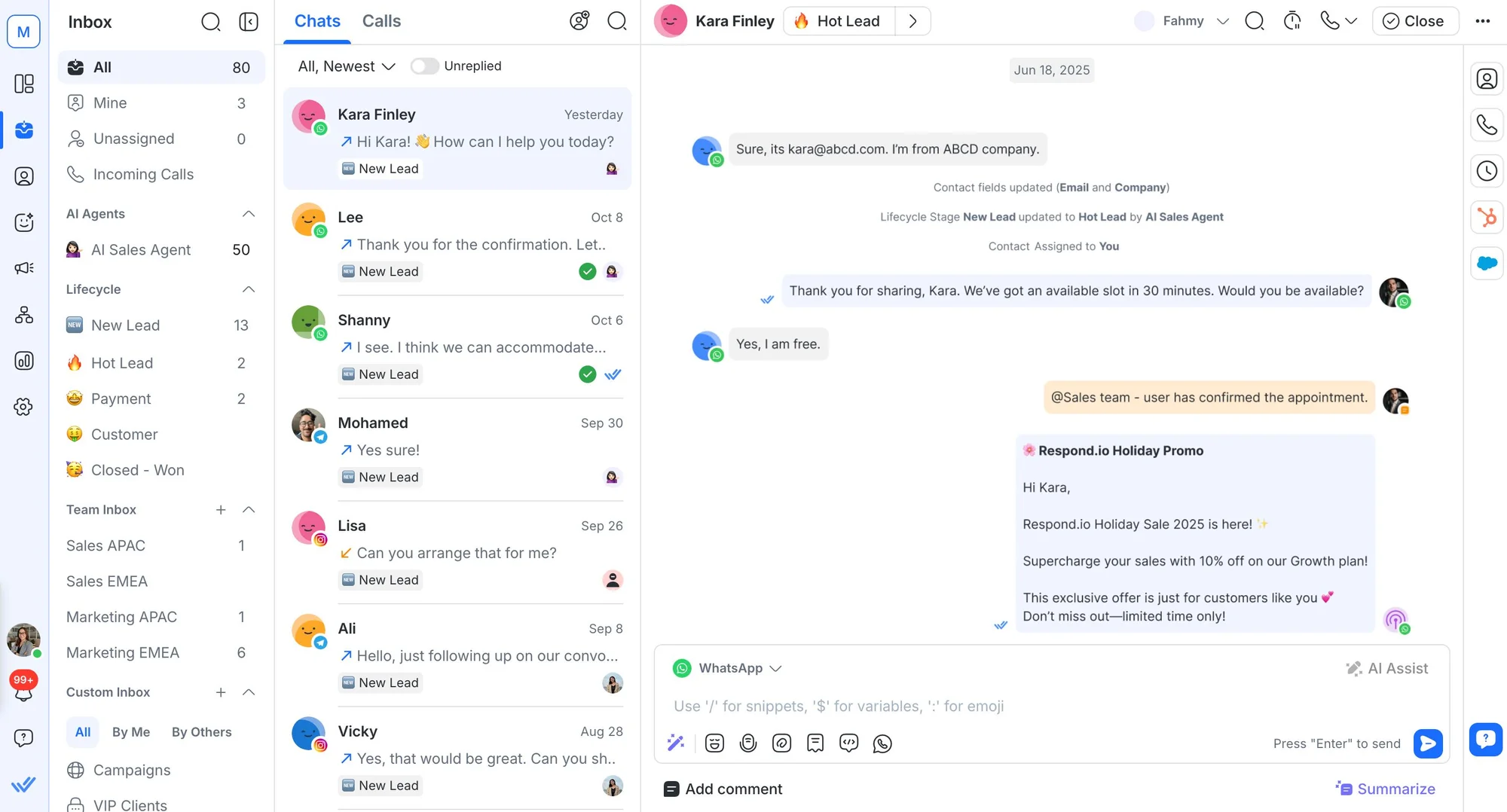
At its core, respond.io is a team inbox — a shared workspace where every customer
conversation, regardless of channel, lands in one place. But calling it “just an inbox” undersells it
considerably. The platform is built around a framework it calls Conversation-Led Growth™, which splits the customer journey into three
connected stages: Capture, Convert, and Retain.
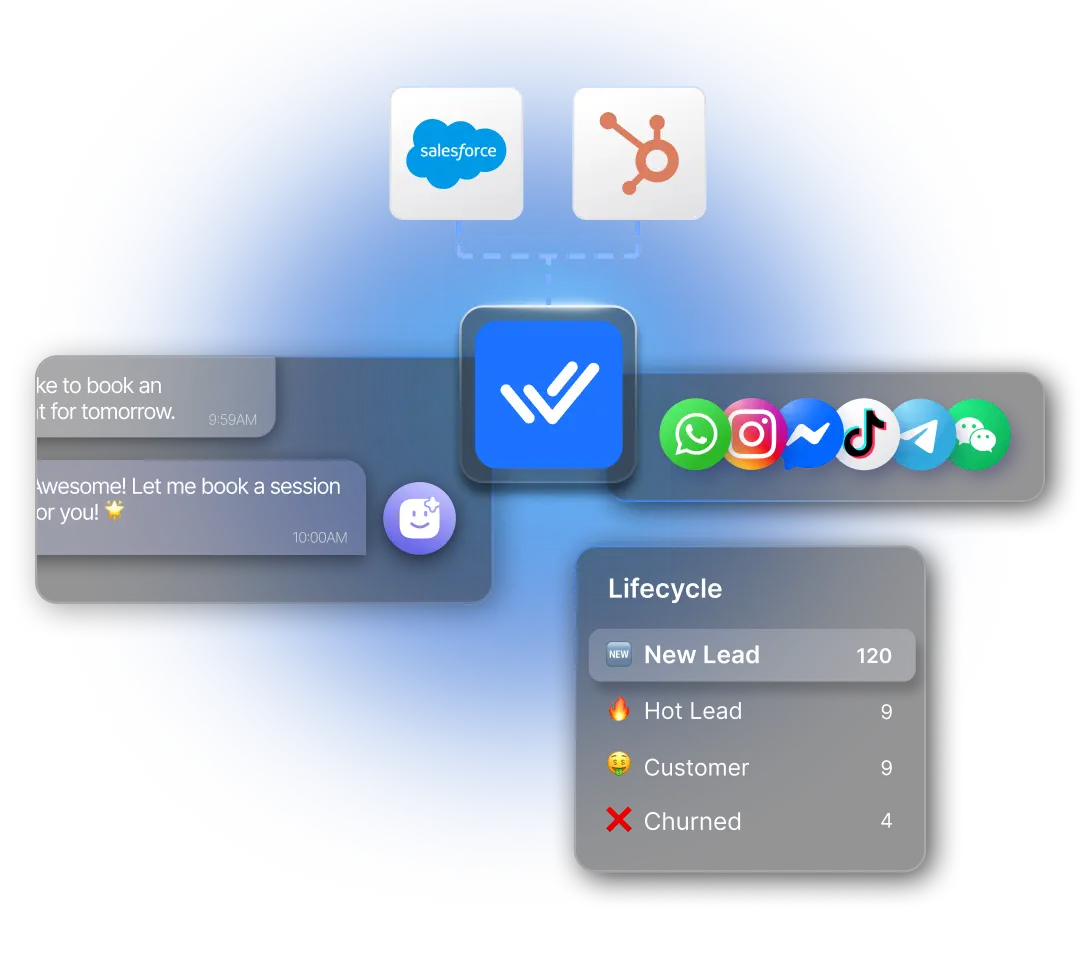
Capture is about pulling leads in from wherever
they originate — Facebook and Instagram ads, TikTok, organic social messages, website widgets, or even
offline touchpoints like a QR code at a physical store — and organizing them into clean, unified customer
profiles that sync with your CRM. The idea is simple but often poorly executed elsewhere: no matter which
channel a lead comes from, their information should end up in one tidy record instead of scattered across
five different tools.
Convert is where respond.io’s AI Agents take
center stage. Instead of a human agent manually triaging every single inbound message, AI Agents can answer
FAQs, qualify leads, recommend products, schedule appointments, and route only the genuinely promising
conversations to a human salesperson. This is the layer that’s supposed to save your team from drowning in
repetitive questions so they can spend their energy on customers who are actually ready to buy.
Retain covers what happens after the sale —
renewal reminders, promotional broadcasts, newsletters, and in-chat CSAT or NPS surveys, all sent through
the same channels customers already use daily. The logic here is sound: it’s far cheaper to keep an existing
customer engaged over WhatsApp than to acquire a new one through paid ads.
What ties the whole framework together is a genuinely distinctive feature: respond.io
unifies chats, voice calls, and email in a single conversation thread. WhatsApp Business Calls, Messenger
Calls, and VoIP calls all show up alongside your text messages for the same customer, which means an agent
can glance at one thread and see the entire relationship history — not just the last chat message, but the
call that happened yesterday and the email that came in this morning. For any business where phone
conversations still matter (real estate, healthcare, automotive, travel), this alone can be worth the price
of admission.
Who Actually Uses Respond.io?
Respond.io says it’s trusted by more than 10,000 B2C brands across over 85 countries,
and its customer logos back that up — Toyota, McDonald’s, British Airways, Radisson Hotels, Subway, Hertz,
and Decathlon all appear in its case study library. That’s a wide spread, but the pattern that emerges from
its published customer stories is telling: this is a platform that clicks hardest with businesses running
high-volume, high-touch B2C sales and support operations.
Some of the results in its case studies are eye-catching, even if — as with any
vendor-published statistics — they should be read as best-case outcomes rather than universal guarantees:
A travel agency reported closing 10x more sales after adopting VoIP
and WhatsApp API calling.
A healthcare provider said it now manages 10,000+ monthly patients
across 34 voice and chat channels using AI Agents.

An appointment-based medical business cut booking friction and sped
up appointment bookings by 62%.
A car dealership network centralized WhatsApp conversations across 47
branches that had previously been managed on scattered personal phones.
A tour operator automated 80% of visa inquiries using an AI Agent,
freeing staff for higher-value conversations.
The industries respond.io explicitly targets — retail, education, healthcare,
professional services, automotive, and travel — all share a common trait: they involve a relatively long,
conversation-heavy buying journey where a lead might chat, call, and email before ever converting. If your
business fits that mold, the platform’s design decisions start to make a lot of sense. If you’re running a
purely transactional e-commerce store where customers rarely need back-and-forth conversation, you may not
need this level of conversational infrastructure.
The AI Agents: The Real Selling Point
It would be easy to dismiss “AI Agents” as another rebrand of a chatbot, given how
liberally that language gets used across the industry right now. But respond.io’s implementation is a step
beyond the rule-based flowcharts that used to pass for chatbots a few years ago.
These AI Agents can be built from templates — sales agent, support agent, receptionist
— or created from scratch, and they can be trained directly on a business’s own data, including website
content and uploaded documents. Rather than following a rigid decision tree, they’re designed to understand
intent, decide on an appropriate action, and actually carry it out: updating a CRM record, recommending a
specific product, checking availability and booking an appointment, or sharing payment details to close a
sale, all without human intervention. Multilingual support means a single agent configuration can serve
customers across different markets without spinning up separate workflows for each language.
The company reports some genuinely strong aggregate numbers from its AI Agent
customers: a 60% faster sales cycle, an 81% conversion rate on AI-handled conversations, and up to 42.5x ROI
in one case. Numbers like these deserve healthy skepticism — they’re cherry-picked success stories, not an
average across the full customer base — but the pattern across independent case studies (visa inquiries,
appointment bookings, insurance lead response times) is consistent enough to suggest the AI layer is doing
real work, not just marketing theater.
Importantly, respond.io frames these agents around guardrails and reliability rather
than pure autonomy. The pitch is “advanced reasoning, high accuracy, and built-in guardrails” — a tacit
acknowledgment that unleashing an unsupervised AI on real customer conversations is risky, and that
businesses need some assurance the agent won’t go off-script in ways that damage trust or leak the wrong
information.
Reliability and Security: The Unsexy Stuff That Actually Matters
Anyone who has run a business on a messaging platform knows that uptime and security
aren’t nice-to-haves — they’re existential. If your team’s only channel to customers goes down during a sale
or a service outage, the damage compounds fast.
Respond.io advertises 99.999% uptime, is ISO 27001 certified, and claims GDPR
compliance. It’s also formally recognized as a Meta Business Partner and a TikTok Marketing Partner, which
in practice means it gets earlier access to new platform features and API changes than smaller, unofficial
integrations — a meaningful advantage in a space where messaging platform policies shift often and without
much warning.
For businesses operating in regulated industries — healthcare and financial services
in particular — those certifications aren’t a checkbox exercise. GDPR compliance affects how customer data
can be collected, stored, and processed for any business serving EU customers, and ISO 27001 certification
signals that respond.io has gone through an external audit of its information security management practices
rather than simply claiming to take security seriously. Combined with a publicly listed subprocessors page
and a formal Data Protection Addendum available for enterprise customers, respond.io gives compliance and
legal teams the paper trail they typically need before signing off on a new vendor — something smaller,
newer competitors in this space often can’t yet provide.
That said, it’s worth being honest about the friction points that show up in
independent, non-vendor reviews. Reviews on sites like Capterra include at least one account of a customer
requesting a refund after a downtime incident and being turned down — a reminder that even a platform with
strong headline uptime numbers can have rough edges in individual support interactions. Another recurring,
if narrower, complaint concerns WhatsApp’s outbound calling restrictions for US-based users, which is a
limitation tied to Meta’s own policies rather than something respond.io controls, but it’s still a real gap
for American businesses hoping to lean heavily into the voice-calling feature.
Integrations, Developer Access, and Getting Started
One thing that separates respond.io from the crowded field of “WhatsApp inbox” clones
is how seriously it treats extensibility. The platform maintains a dedicated Developer Hub with guides and
documentation for building custom integrations, which matters a great deal once a business grows past the
point where out-of-the-box CRM syncing covers every workflow. For teams running a bespoke tech stack — a
proprietary booking system, a niche ERP, an internal ticketing tool — the ability to wire respond.io into
that stack via API rather than being boxed into a handful of pre-built connectors is a meaningful long-term
advantage.
On the pre-built side, respond.io already connects with the channels that matter most
for B2C messaging — WhatsApp Business API, Instagram, Messenger, TikTok, SMS, and email — alongside CRM
syncing so that customer profiles built inside respond.io don’t become yet another data silo. This
channels-and-integrations layer is really the plumbing that makes the entire Capture stage of the
Conversation-Led Growth framework function; without it, “unifying every touchpoint” would just be marketing
language.
Onboarding is another area where respond.io seems to have invested more than most
competitors in its price bracket. New users are guided through an interactive product tour that doesn’t
require signing up first — you can explore a working demo environment before ever creating an account, which
is a rarer and more respectful approach than the typical “book a demo call to see the product” gatekeeping
many B2B SaaS tools still rely on. Independent reviewers echo this: despite the platform’s depth, most
describe the learning curve as manageable, aided by contextual pop-ups and walkthroughs that introduce
advanced functionality gradually rather than dumping the entire feature set on a new user at once.
The company also runs a public roadmap where customers can submit and vote on feature
requests — a small but telling detail, since it signals that product decisions are at least partly steered
by paying users rather than made entirely behind closed doors. Combined with 24/7 human and AI-assisted
support, and a help center stocked with step-by-step configuration guides, the overall onboarding experience
reads as one of respond.io’s quieter competitive advantages: it’s not just that the platform can do a lot,
it’s that a mid-sized team without a dedicated in-house engineer can realistically get it running.
Pricing: Where the Real Homework Begins
This is the part of any respond.io review that deserves the most scrutiny, because the
sticker price and the real-world bill can diverge more than most buyers expect.
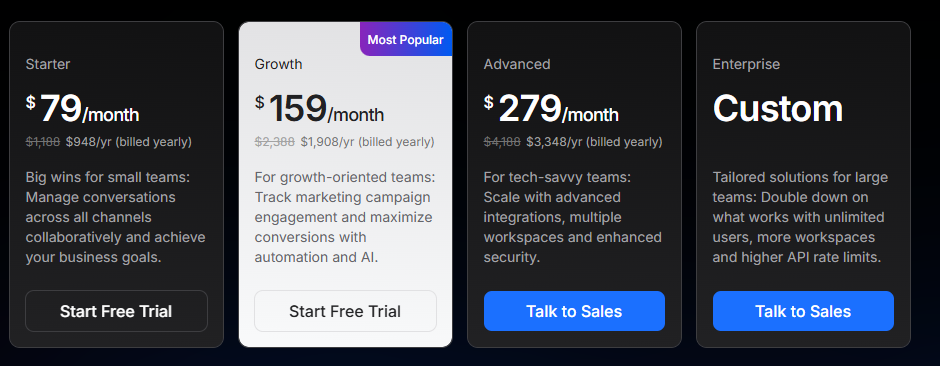
As of 2026, respond.io runs four tiers — Starter, Growth, Advanced, and Enterprise —
and pricing scales along two independent levers: Monthly Active Contacts (MACs), meaning unique contacts who
send or receive a message within a billing period, and Users, the number of workspace seats. Growth and
Advanced plans include 1,000 MACs by default, with additional contacts billed on top.
Advertised entry pricing sits around $79–$99 per month depending on the source and
billing cycle (annual billing typically unlocks roughly a 20% discount over monthly), but that Starter tier
is essentially a live-chat inbox — the automation, AI Agents, and workflow features that make respond.io
genuinely powerful are locked behind the Growth plan, which starts around $159/month. Independent reviewers
have found that a mid-sized team running realistic contact volumes, a handful of seats, and moderate
WhatsApp usage can end up paying somewhere between $400 and $700 per month once MAC overages and per-seat
costs are factored in — a meaningful jump from the headline number.
There’s an additional wrinkle specific to WhatsApp: Meta’s own messaging fees sit on
top of respond.io’s subscription and are billed separately. International authentication messages (like
OTPs) sent to a country different from where the WhatsApp Business Account is registered can be charged at
rates 3x to 20x higher than domestic ones — a cost driven by Meta’s pricing structure, not respond.io’s, but
one that catches international businesses off guard if they haven’t budgeted for it.
None of this makes respond.io overpriced — its G2 rating and case studies suggest most
customers feel they get real value back — but it does mean the honest advice is: don’t budget off the
homepage price. Model out your expected contact volume, seat count, and messaging fees before committing,
and treat the advertised number as a floor rather than a forecast.
How It Compares to the Alternatives
Respond.io doesn’t operate in a vacuum. It competes most directly with platforms like
SleekFlow, Wati, Trengo, and Manychat, and respond.io publishes direct comparison pages against all of them
— a sign of confidence, though naturally the framing favors respond.io in each case.
Independent, user-driven data from G2 tells a more balanced story. In head-to-head
comparisons:
Respond.io vs. SleekFlow:
respond.io holds a 4.8/5 rating (459 reviews) against SleekFlow’s 4.6/5 (193 reviews). G2’s
aggregated user sentiment gives respond.io the edge specifically on ease of use, ease of setup, ease
of admin, and quality of support — all scoring in the 9.0–9.3 range compared to SleekFlow’s 8.3–8.6
range. SleekFlow does offer a free entry tier, which respond.io does not.
Respond.io vs. Trengo:
respond.io again leads on overall rating (4.8 vs. 4.3) and is generally viewed as more intuitive for
managing multiple channels, according to aggregated G2 reviewer sentiment. Trengo’s entry pricing
(around €349/month for 10 users) is structured differently and can be more expensive for larger
teams out of the gate.
The consistent theme across these comparisons is that respond.io wins on usability,
support quality, and analytics depth, while its main trade-off is that it’s rarely the cheapest option on
the table, and its most valuable features are gated behind higher tiers. If your priority is the lowest
possible entry price or a genuinely free plan to test the waters, competitors like SleekFlow have an edge.
If your priority is a platform that scales cleanly into serious automation and AI without hitting obvious
feature ceilings, the G2 data and case study volume suggest respond.io is the stronger long-term bet.
The Good, The Bad, and The Honest Verdict
What respond.io does well:
Genuinely unifies chat, voice calls, and email into one coherent
conversation thread — a feature few competitors match with the same depth.
AI Agents that go beyond scripted chatbot flows, capable of taking
real actions like updating CRM records and booking appointments.
Strong, independently verified reputation: a 4.8/5 G2 rating across
hundreds of reviews, ISO 27001 certification, and official Meta and TikTok partner status.
A clear, three-stage growth framework (Capture, Convert, Retain) that
gives structure to what could otherwise be a chaotic sprawl of features.
Consistently praised customer support, which matters enormously for a
platform this central to daily operations.
Where it falls short:
Pricing is genuinely confusing at first glance, with Monthly Active
Contacts, per-seat costs, and Meta’s separate WhatsApp fees all compounding the real monthly bill
well beyond the advertised starting price.
The most powerful features — automation, AI Agents, workflows — are
locked behind the $159/month Growth tier and above, making the platform a tough sell for very small
businesses or solo operators.
No permanent free plan, unlike some competitors.
Certain limitations, like WhatsApp outbound calling restrictions for
US users, are outside respond.io’s control but still affect the experience for specific markets.
Occasional friction in support resolution for edge cases like
downtime disputes, based on individual customer reviews.
The bottom line: Respond.io isn’t trying to be the cheapest chat widget on the market,
and it shouldn’t be judged as one. It’s a serious, mature platform built for businesses that are past the
stage of manually juggling a handful of WhatsApp conversations and have hit the point where lost context
between channels is actively costing them sales. For a mid-sized or enterprise B2C business fielding real
volume across WhatsApp, Instagram, TikTok, and voice — especially one where a lead might chat, call, and
email before converting — respond.io’s combination of unified conversation threads, genuinely capable AI
Agents, and a track record with recognizable global brands makes a compelling case.
If you’re a solo founder testing your first automated WhatsApp flow, the entry price
and feature gating will likely feel like overkill, and a lighter, cheaper tool might serve you better until
you outgrow it. But for everyone else — the businesses drowning in the exact problem this review opened
with, where a customer’s story gets lost every time they switch channels — respond.io looks less like
another SaaS subscription and more like the connective tissue your customer operations have been missing.
Before committing, it’s worth running your own numbers: estimate your expected monthly
active contacts, the number of seats your team actually needs, and your realistic WhatsApp messaging volume
(including any international authentication messages), then compare that projected total against the
platforms you’re evaluating. Most reputable reviews agree on one thing — respond.io’s product quality isn’t
the question mark. Its pricing structure is the part that rewards careful planning.