
Our Rigorous Editorial Policy: The TrendLevelTech Standard
At TrendLevelTech, we believe that a technology review should be more than just a surface-level summary—it must be the definitive result of a rigorous, closed-loop testing ecosystem. Our Editorial Policy is built on the principle that we don’t just “try” software; we stress-test every feature, integration, and security protocol to ensure our readers never encounter hidden technical debt or suboptimal performance.
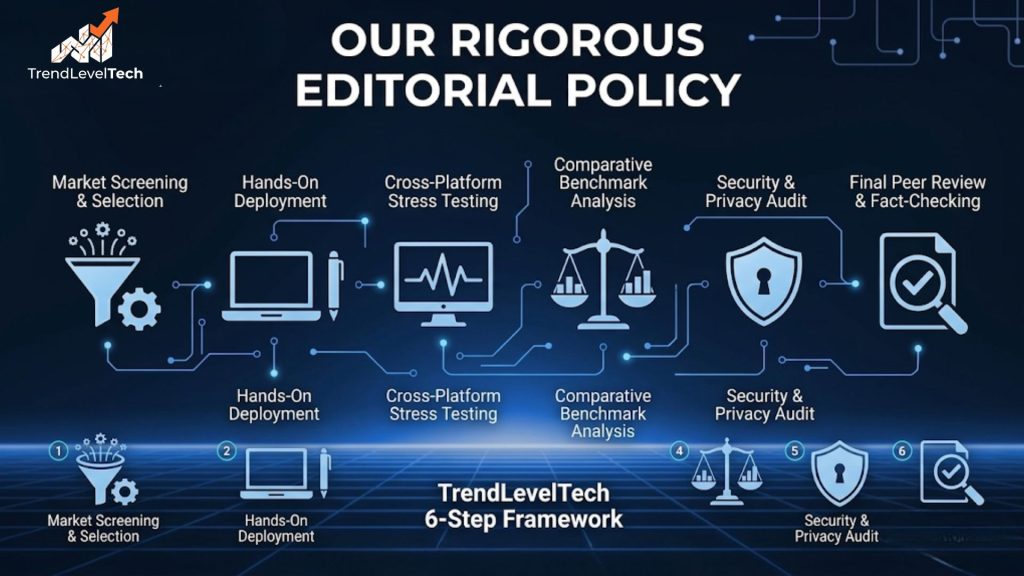
To maintain the highest level of journalistic integrity and technical accuracy, every tool, SaaS platform, and digital asset evaluated on our site must pass through the Trend Level Tech 6-Step Framework. This Editorial Policy ensures that our content remains unbiased, data-driven, and highly actionable for our global community of tech enthusiasts.
The TrendLevelTech 6-Step Evaluation Framework:
Final Peer Review & Fact-Checking: Before any article is published, it undergoes a final editorial sweep. Our senior tech leads verify every data point to ensure our Editorial Policy of absolute accuracy is upheld.
Market Pre-Screening & Selection: We filter through thousands of emerging tools to select only those that solve real-world problems. Our Editorial Policy mandates that we prioritize innovation and user demand over marketing hype.
Hands-On Deployment: Unlike many “review” sites that rely on press releases, our team initiates full-scale deployment. We go through the actual sign-up, installation, and configuration process to mirror the true user journey.
Cross-Platform Stress Testing: We push the boundaries of each tool. From testing API responsiveness to checking mobile-desktop synchronization, we ensure the software holds up under heavy workloads.
Comparative Benchmark Analysis: We don’t review in a vacuum. Every tool is benchmarked against its top industry competitors to provide a clear perspective on value-for-money and feature superiority.
Security & Privacy Audit: As part of our commitment to digital safety, we scrutinize the data handling practices and encryption standards of every SaaS platform we recommend.
The “Stress Test” Phase: Engineering Reliability into Every Review
Within the framework of our Editorial Policy, the “Stress Test” phase is where we separate marketing hype from functional reality. We believe that a tool’s true value isn’t found in its promotional videos, but in how it performs under extreme technical pressure. At Trend Level Tech, we push every software, SaaS platform, and digital infrastructure to its absolute breaking point before it ever receives our recommendation.
Our Editorial Policy mandates a “No-Mercy” testing environment to identify hidden system bottlenecks. For instance, when our team evaluates high-tier project management software, we don’t simply add five or ten tasks to a clean dashboard. Instead, we perform a massive data injection, importing 5,000+ complex tasks simultaneously across multiple team accounts.
What We Monitor During Stress Testing:
- System Latency & API Throttling: We measure the exact millisecond delay between a user command and the server’s response during peak data loads.
- Database Lag & Indexing Speed: We scrutinize how the platform handles deep-search queries when thousands of data points are active.
- UI/UX Responsiveness: We monitor for “frame drops” or interface stuttering that could frustrate a professional user’s workflow.
- Concurrent User Stability: We simulate multiple team members editing the same document or task list to test real-time synchronization integrity.
Our philosophy is simple: If a platform crashes or lags for us during our rigorous internal testing, our Editorial Policy prevents us from recommending it to you. We absorb the technical failures so that our readers can enjoy a seamless, crash-free experience in their own professional lives.
Technical Performance Benchmarking: Data Over Opinion
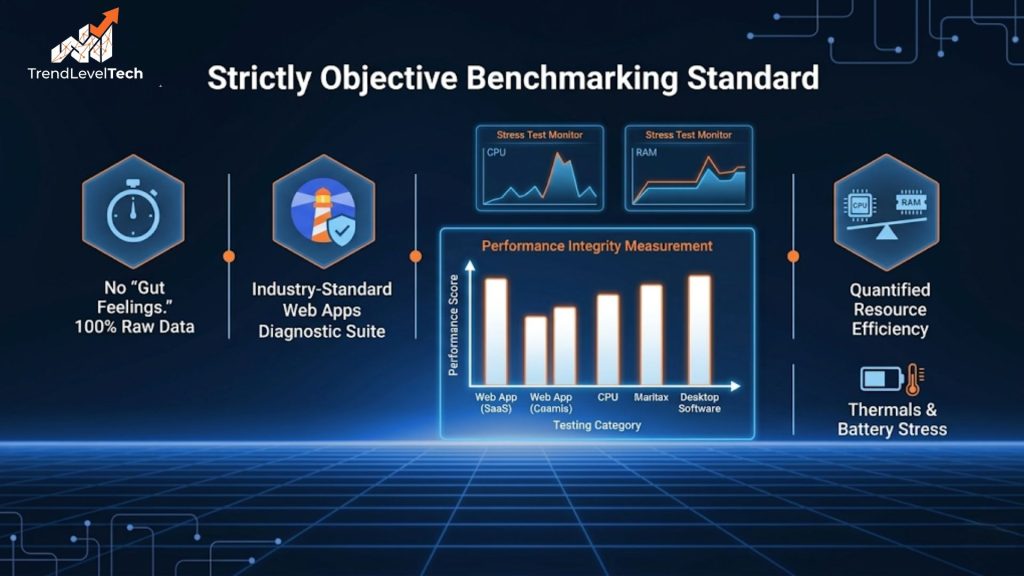
At Trend Level Tech, our Editorial Policy mandates a strictly objective approach to performance evaluation. We believe that subjective opinions and “gut feelings” have no place in a professional performance metric. To ensure our readers receive the most accurate data, we rely on a suite of industry-standard diagnostic tools to quantify the efficiency of every web application, SaaS platform, and desktop software we review.
How We Measure Performance Integrity:
Our Editorial Policy requires a dual-layered benchmarking process to provide a comprehensive view of resource efficiency:
- Web Application Analysis: For cloud-based tools and SaaS platforms, we utilize Google Lighthouse and GTmetrix to measure critical performance indicators. We don’t just look at load times; we scrutinize Largest Contentful Paint (LCP), Total Blocking Time (TBT), and Cumulative Layout Shift (CLS) to ensure the software meets modern Core Web Vitals standards.
- Desktop & Native App Stress Testing: For local applications, we deploy dedicated hardware resource monitors. Our Editorial Policy dictates that we report exact CPU utilization cycles, RAM consumption (MB/GB), and GPU acceleration impact across various operating systems.
- Thermal & Battery Impact: We monitor how “heavy” a piece of software is on mobile workstations, tracking battery drain percentages and thermal throttling to help you understand the real-world hardware cost of running these tools.
Transparent Reporting Standards:
The goal of this benchmarking phase is to remove the guesswork. By documenting precise hardware footprints, our Editorial Policy empowers you to know exactly how a tool will behave on your specific setup—whether you are running a high-end workstation or a mid-range laptop. We provide the raw data, so you can make informed decisions based on technical facts, not marketing promises.
Security & Permission Audit: Privacy is Non-Negotiable
In an era of increasing data breaches, your digital privacy is a foundational pillar of our Editorial Policy. We believe that no tool, regardless of its utility, is worth compromising your personal information. Our team performs a comprehensive “Deep Scan” of every permission request and background process associated with the software we review.
Our “Red Alert” Protocol:
Our Editorial Policy mandates a strict zero-tolerance approach to invasive data collection. If a simple photo editor demands unnecessary access to your contacts, SMS history, or precise GPS location, we immediately trigger a “Red Alert” warning for our readers. We scrutinize:
- Data Minimization: Does the app only ask for what it truly needs to function?
- Background Tracking: Does the software attempt to monitor your activity when not in use?
- Encryption Standards: We verify if your data is protected by industry-standard AES-256 or end-to-end encryption.
We don’t just review features; we audit your safety. If a tool fails our security integrity check, our Editorial Policy ensures you are the first to know—so you can navigate the digital landscape with total peace of mind.
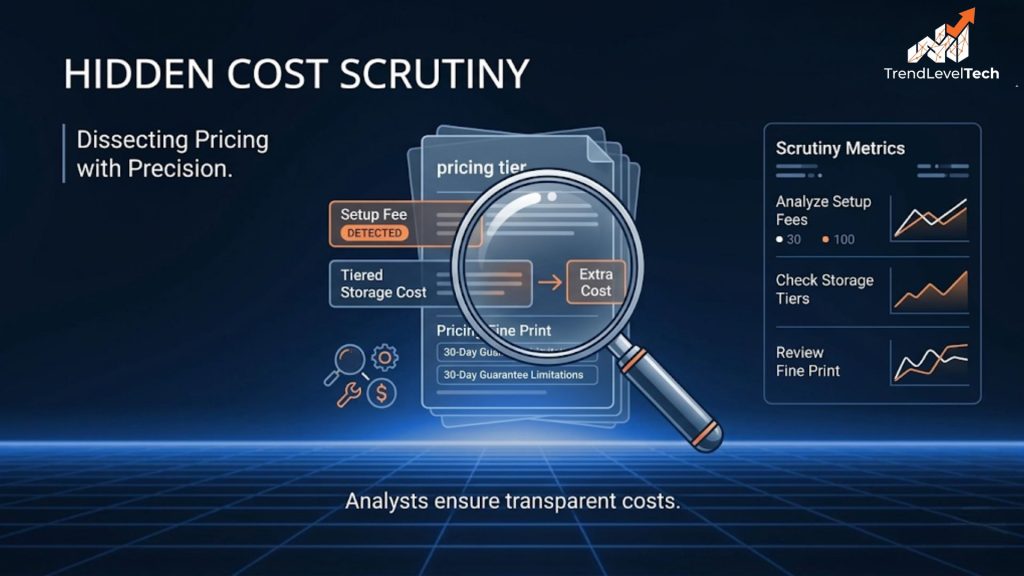
Hidden Cost Scrutiny
We dissect the “Pricing” page with a magnifying glass. Our analysts hunt for hidden setup fees, tiered storage costs, and the fine print in “30-day money-back guarantees.” We ensure the price you see is the price you actually pay.
Internal Peer Review (The Devil’s Advocate)
No review is published without internal friction. After Editor A completes a review, Editor B—often someone with a conflicting viewpoint—is assigned to use the tool and identify weaknesses that Editor A might have overlooked. This ensures a balanced, unbiased perspective.
Retroactive Updates
Technology moves fast, and static reviews become obsolete. Whenever a software releases a major Version Update, we revisit our original content. Every post is timestamped with a “Last Updated” date, ensuring you never make a decision based on outdated information.