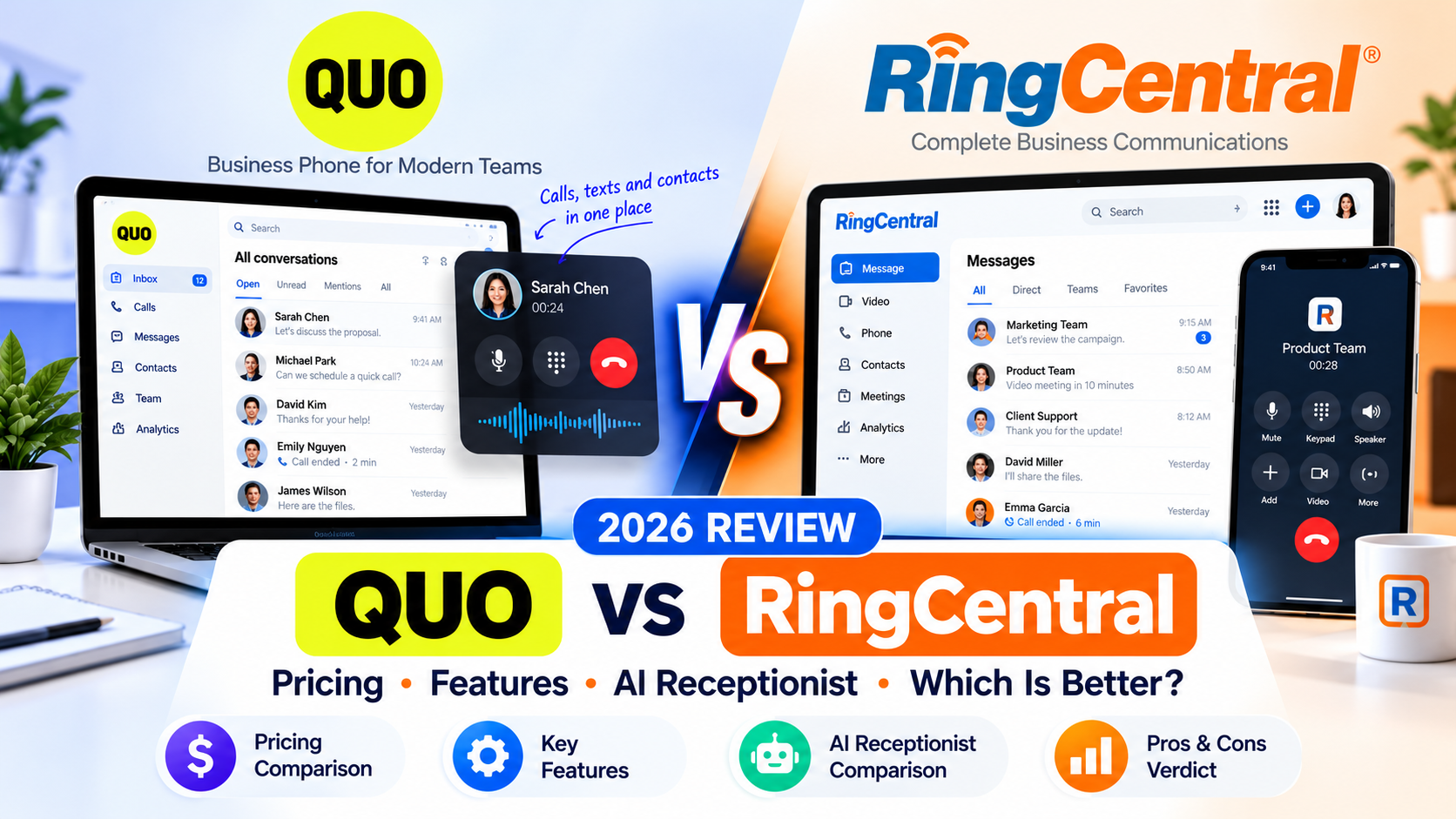
An in-depth, independent editorial comparison of Quo (formerly OpenPhone) and RingCentral for small businesses, growing teams, and enterprise organizations.
Updated: July 17, 2026 | Category: Business Phone Systems, VoIP & Cloud Communications
Affiliate disclosure: This article may contain affiliate links. Trendleveltech may earn a commission from qualifying purchases at no additional cost to you. Our recommendations are based on publicly available documentation and editorial analysis.
1. Quick Verdict: Quo vs RingCentral — Which Is Better?
Quo and RingCentral both deliver cloud-based business communications, but they solve somewhat different problems. Quo concentrates on customer conversations, shared business numbers, SMS, team collaboration, and its Sona AI receptionist. RingCentral provides a broader communications ecosystem designed to serve organizations with more varied telephony, administration, device, and collaboration needs.
For a five-person agency, the ability to share customer messages and keep every employee informed may matter more than enterprise telephony. For a 500-person company with multiple locations, central administration, hardware compatibility, and formal communications policies may be decisive.
Choose Quo if you need
- Shared business numbers and customer conversation histories.
- Business texting and team collaboration in one workspace.
- AI-assisted call answering for routine or after-hours inquiries.
- An approachable system for a small or growing customer-facing team.
Consider RingCentral if you need
- A broader business communications portfolio.
- More extensive telephony administration and multi-location planning.
- Compatibility with traditional business calling hardware.
- Specialized enterprise or contact-center solutions.
Quick verdict: Quo is our preferred starting point for small and growing customer-facing teams. RingCentral deserves closer consideration for more complex organizational communications. Neither is universally better.
Want the Complete Quo Review Before You Decide?
Explore Quo’s features, Sona AI, pricing, security, integrations, strengths, and limitations in our dedicated 2026 review.
Read Our In-Depth Quo Review ↗
Independent editorial analysis to help you evaluate Quo before subscribing.
2. What Is Quo?
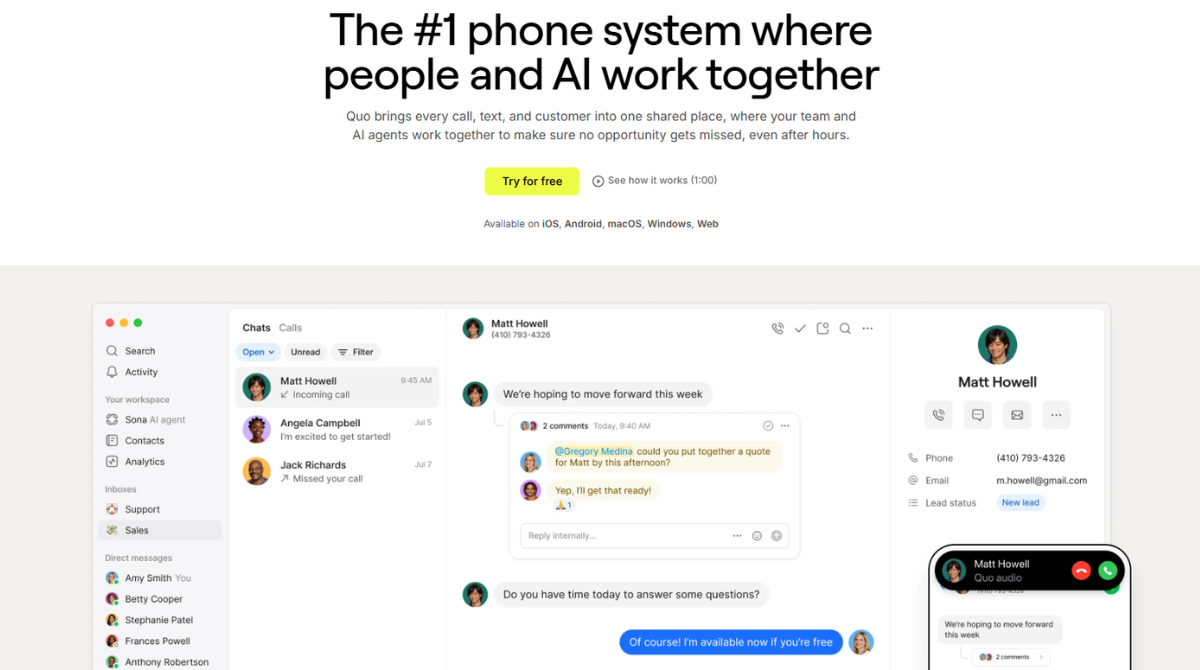
Quo is a cloud-based business phone and customer communication platform formerly known as OpenPhone. It combines eligible business phone numbers, calling, SMS/MMS, voicemail, shared inboxes, contact histories, internal team collaboration, and configurable call handling.
Its core idea is that customer communication should belong to the business, not be scattered across individual employees’ personal devices. Authorized colleagues can work from shared numbers and access relevant histories, reducing the need for customers to repeat information when another employee takes over.
Where Quo stands out
- Shared customer conversations and collaborative texting.
- Internal coordination around customer interactions.
- Sona AI for configured incoming-call workflows.
- CRM connections and automation options.
- Business-focused calling and messaging across supported devices.
Quo is not a complete CRM or a replacement for every enterprise contact-center product. Advanced routing, call summaries, recording, and some integrations depend on the selected subscription tier.
3. What Is RingCentral?
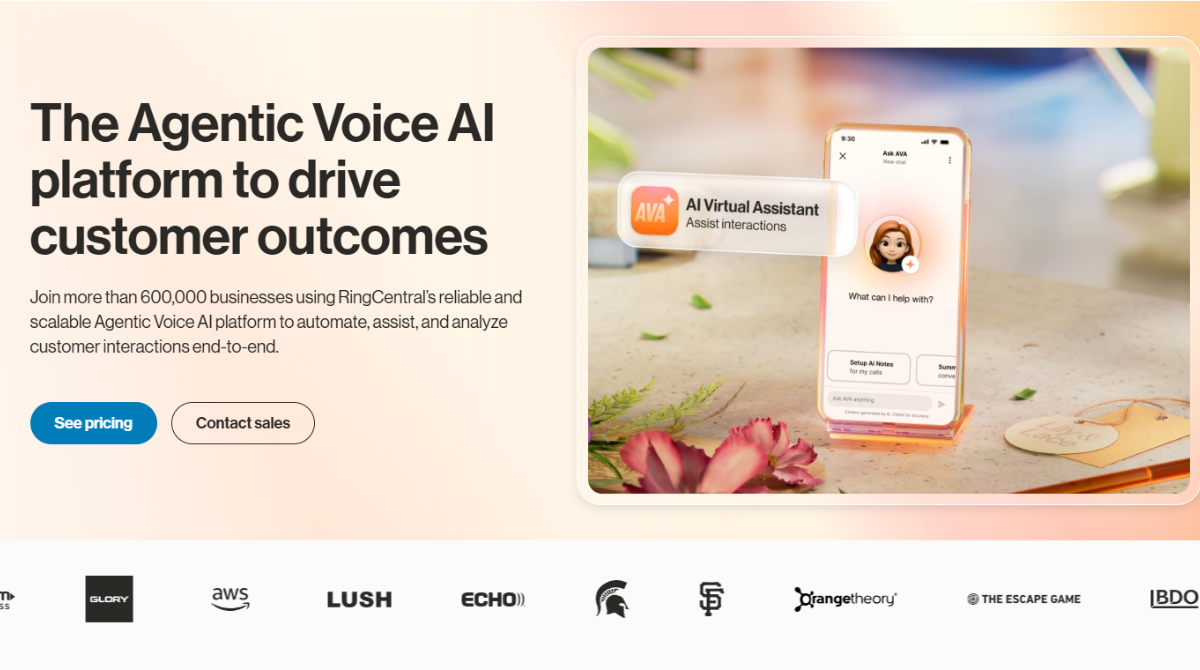
RingCentral provides cloud communications and customer engagement products. Its RingEX offering combines business calling with messaging, meetings, and related collaboration capabilities, while its wider product portfolio addresses additional communication and contact-center needs.
RingCentral can be especially relevant when a company needs centrally administered communications across departments, locations, and compatible devices. This breadth can also increase purchasing and deployment complexity for businesses with simpler requirements.
Where RingCentral stands out
- Broad business communications ecosystem.
- Options relevant to multi-location and enterprise environments.
- Support for compatible desk phones and other calling devices.
- Established integrations with business productivity tools.
- Additional products for specialized communications requirements.
4. How We Compared Quo and RingCentral
This comparison examines published pricing, calling, messaging, shared collaboration, AI receptionists, routing, integrations, administration, security disclosures, and business suitability. We distinguish provider claims from our own editorial conclusions.
Testing limitation: We have not independently benchmarked call quality, uptime, latency, AI accuracy, or the providers’ security infrastructure. Product features and prices can change. Use the official sources linked below to verify current conditions before purchasing.
5. Pricing and Total Cost Comparison
The advertised per-user subscription price is only the beginning of a meaningful comparison. Extra numbers, messaging registration, international usage, AI call volume, premium integrations, and optional services may alter the final invoice.
Quo subscription prices
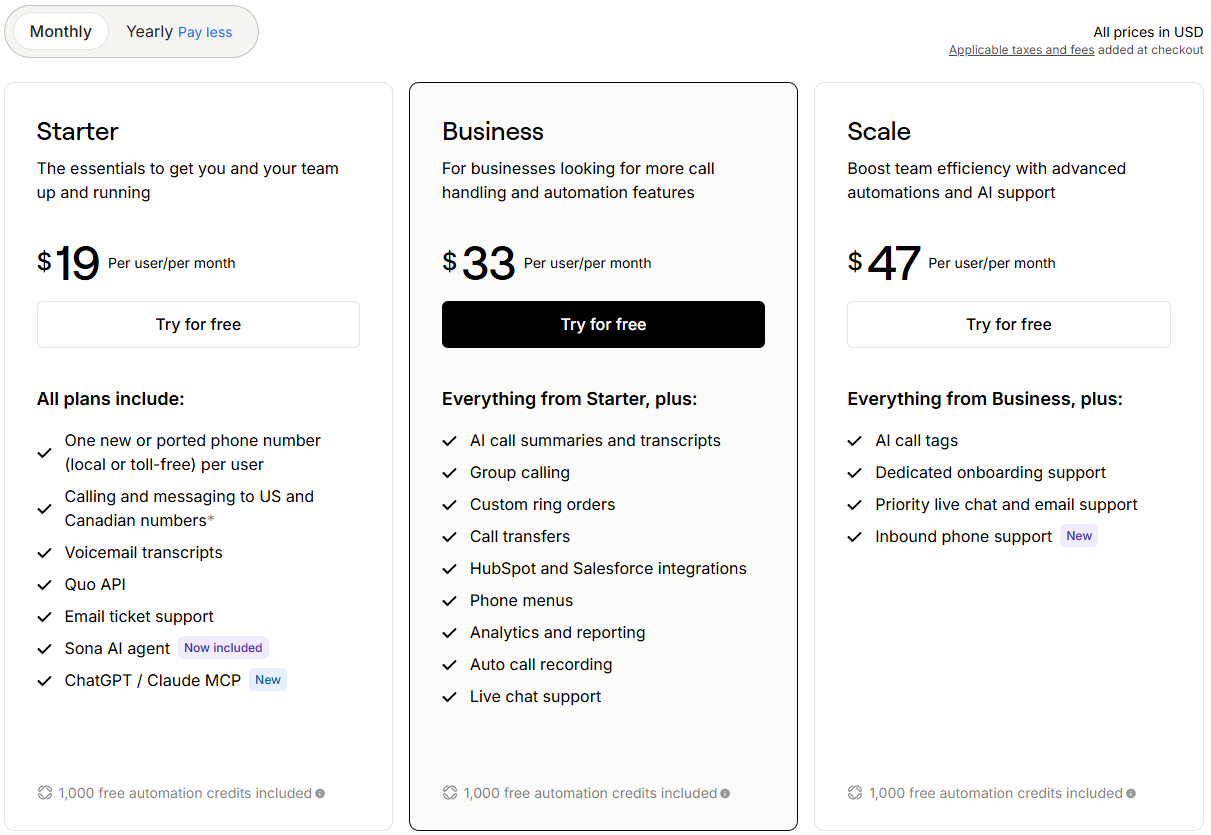
Starter: $15 per user/month billed annually, or $19 billed monthly. It targets basic calling and messaging requirements and includes a limited Sona automation-credit allowance.
Business: $23 per user/month billed annually, or $33 billed monthly. It adds functionality such as AI call summaries, automatic recording, phone menus, group calling, transfers, analytics, and eligible CRM integrations.
Scale: $35 per user/month billed annually, or $47 billed monthly. It includes additional onboarding, support, and AI-related administrative capabilities. These figures are published plan prices, not guaranteed quotes.
RingCentral subscription prices
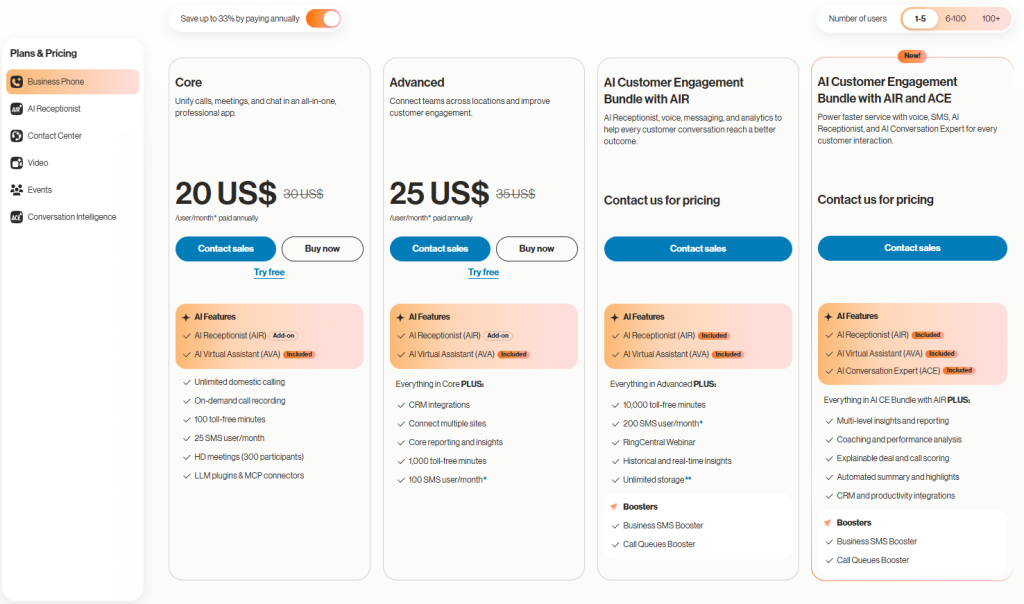
Quo’s competitor comparison cites a RingCentral starting price of approximately $20 per user/month with annual billing. RingCentral’s actual prices depend on the product, plan, billing arrangement, and purchasing terms. Always confirm the selected RingEX configuration directly with RingCentral rather than treating a competitor’s comparison as a quotation.
Scenario: Five-person team
Five Quo Business seats at the annual-billing monthly equivalent cost 5 × $23 = $115 per month, or $1,380 per year before optional services and taxes. At an illustrative $20 starting rate, five RingCentral seats would be $100 per month before any differences in included functionality. Those two configurations are not necessarily feature-equivalent.
Scenario: Ten-person agency with AI call handling
Ten Quo Business seats cost a monthly equivalent of 10 × $23 = $230. Adding a published $49 Sona credit tier yields an illustrative $279 per month, assuming the tier covers the required usage. Additional numbers, taxes, and other usage are excluded.
Potential additional costs
- Extra local or toll-free numbers.
- Messaging registration and SMS-related fees.
- International calling and texting.
- AI receptionist allowances and overages.
- Optional features, add-ons, and premium support.
- Annual commitments, renewal terms, and cancellation conditions.
Pricing verdict: Quo may offer compelling value for teams that need its collaborative messaging and AI options. RingCentral may justify its cost when a business needs a broader communications stack. Compare complete workflows and invoices, not only advertised seat prices.
Find the Right Quo Plan for Your Team
Whether you’re a solo professional or managing a growing team, Quo offers plans for different communication needs. Compare Starter, Business, and Scale to find the right balance of features and cost.
Review current pricing and included features before subscribing.
6. Business Calling: Which Platform Is Better?
Both providers support internet-based business calling, but their product priorities differ. Quo connects calls to customer messages and shared contact histories. RingCentral offers calling within a broader enterprise-oriented communications environment.
Quo calling experience
When a customer texts first and calls later, employees can use the shared communication context to understand earlier requests. This is particularly useful for agencies, service companies, and small support teams where different people may answer at different times.
RingCentral calling experience
RingCentral is worth evaluating for departments with more extensive telephony policies, traditional desk-phone deployments, or multiple office locations. The exact features depend on the plan and deployment.
What about call quality?
No reliable winner can be declared without standardized testing. Internet stability, local network configuration, Wi-Fi, devices, geographic routing, and provider infrastructure all influence VoIP performance. Test real calls using your team’s normal devices and internet connection.
7. Business SMS and Shared Inbox
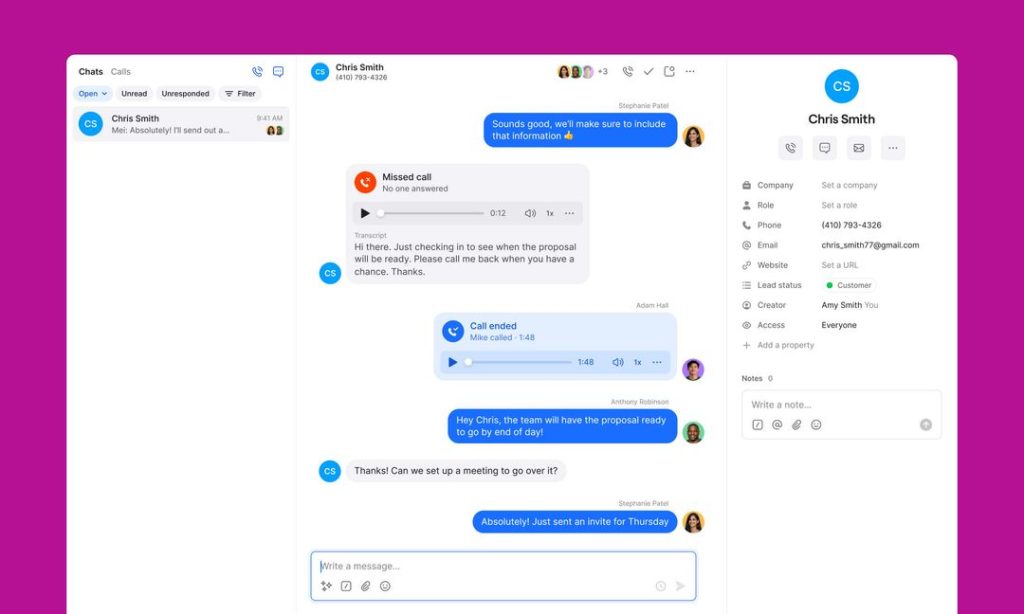
Shared texting is among Quo’s clearest differentiators. A team can work from a shared business number and see relevant customer communication history, reducing dependence on one employee’s device or memory.
A practical example
A property management business receives a maintenance request by text. The employee responsible is away. Another authorized colleague reviews the prior messages, checks the issue, and responds without asking the tenant to repeat everything. Internal discussions can help the team coordinate before sending the customer a reply.
RingCentral also provides business messaging, but buyers must check the included SMS allowances and whether shared texting requires a specific package or add-on. Quo’s comparison page highlights RingCentral’s Business SMS Booster as an additional-cost consideration; verify current availability and charges directly.
Shared inbox verdict: Quo is especially attractive when multiple employees handle the same customer relationships. RingCentral may still be suitable, but the exact shared-messaging configuration matters.
8. AI Receptionist: Quo Sona vs RingCentral AI Receptionist
AI receptionists can answer routine calls and collect information when employees are busy or unavailable. Their real value depends on accurate knowledge, appropriate routing, clear escalation rules, and sustainable usage costs.
Quo Sona
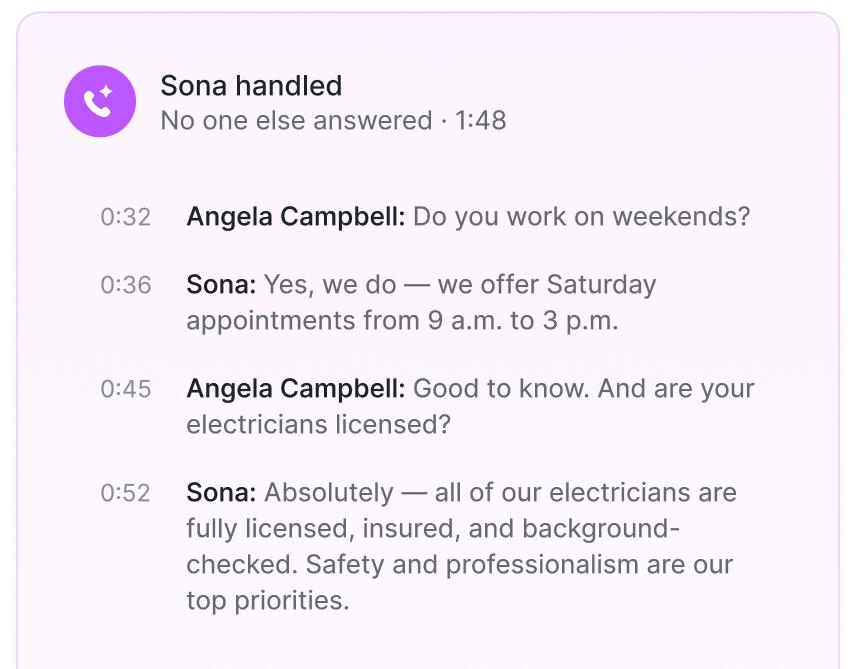
Sona can support configured incoming-call workflows, including answering questions, collecting caller details, identifying inquiry types, sending relevant SMS messages, and transferring selected calls to employees. For example, an after-hours plumbing inquiry could be logged with the caller’s location, issue, and preferred callback time.
RingCentral AI Receptionist
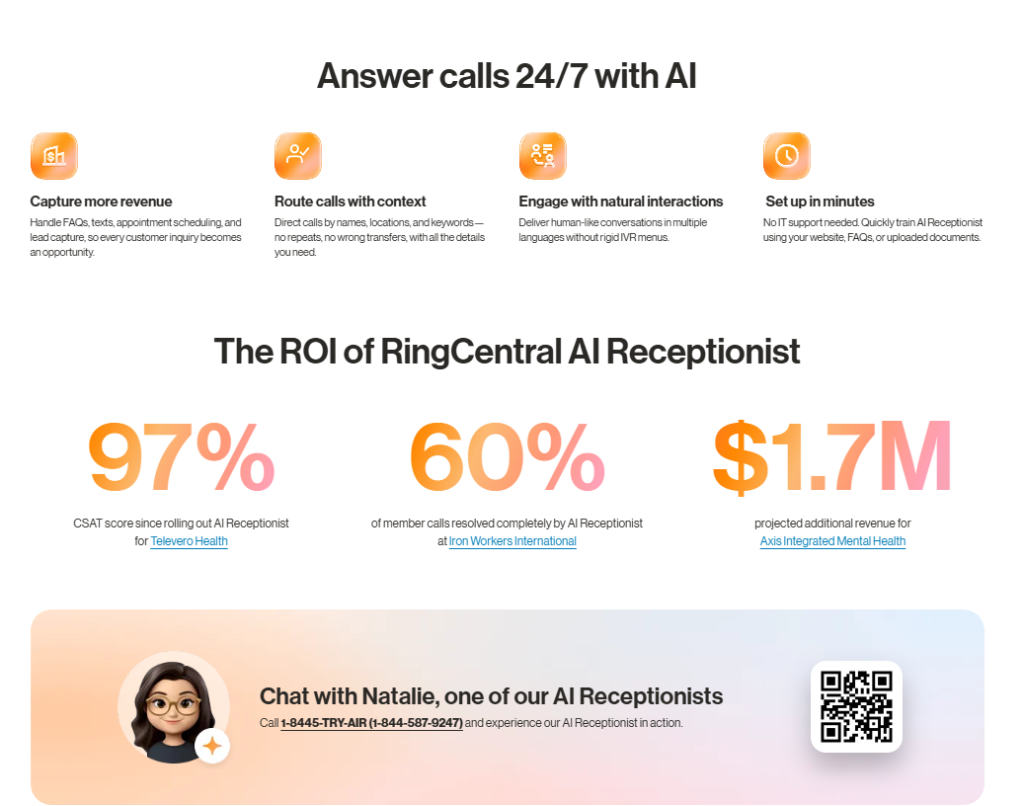
RingCentral offers AI receptionist functionality for automated incoming-call interactions. Buyers should verify supported knowledge sources, call transfers, integration behavior, package eligibility, and the current add-on or standalone price. Do not assume its functionality or billing structure matches Sona.
Sona automation credits
Quo currently publishes 1,000 included automation credits on its primary plans, described as approximately 10 Sona-handled calls. Additional published tiers include $25 for 4,000 credits (~40 calls), $49 for 10,000 (~100), $99 for 25,000 (~250), and $199 for 60,000 (~600). These call equivalents are estimates; check the current usage and overage rules.
What to test before relying on AI
- Can the AI answer your real customer questions accurately?
- Can it recognize when it does not know the answer?
- Can it collect names, addresses, and callback details reliably?
- Does it escalate complaints and sensitive issues to a human?
- What happens when callers interrupt or give unexpected answers?
- How are transcripts, recordings, and customer data handled?
AI verdict: Sona is compelling for smaller teams seeking AI answering inside their shared communication workflow. RingCentral AI Receptionist merits consideration for organizations already invested in RingCentral. Neither should replace human oversight for complex or consequential situations.
See How Sona AI Fits Into Quo
Our complete Quo review explains what Sona can do, where it may fall short, and how its automation credits can affect your total monthly cost.
Understand the AI features and limitations before making a decision.
9. Call Routing, Recording, and Analytics
As call volume increases, routing and documentation become more important. Quo supports eligible phone menus, group calling, transfers, configurable call flows, automatic recording, and AI call summaries. Some of these require Business or higher.
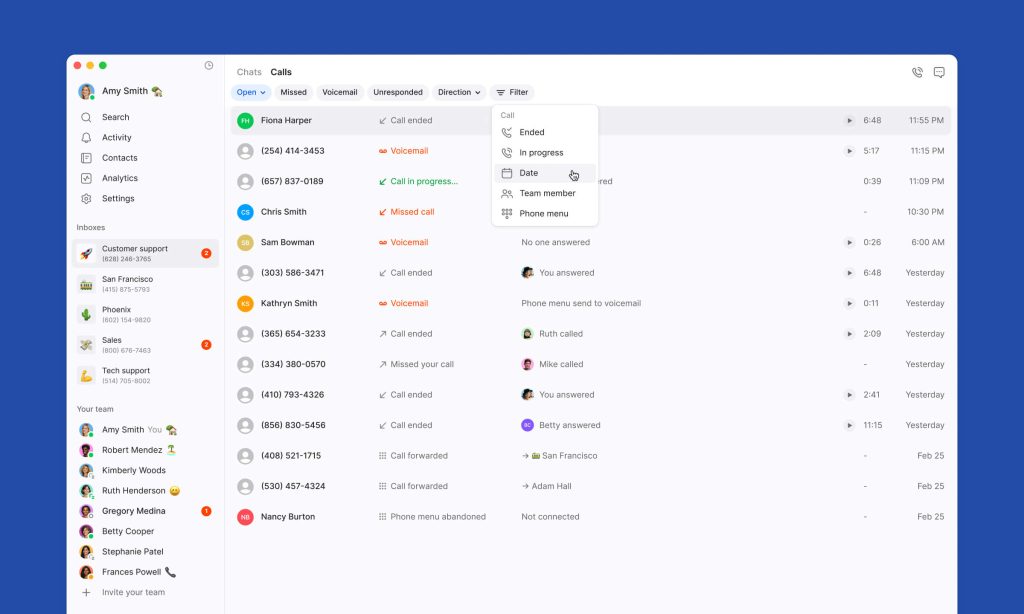
A service company might direct new inquiries to sales, existing appointments to scheduling, and after-hours calls to an AI-assisted process. RingCentral offers communication-management capabilities for a broader range of deployments, but the relevant features must be checked by plan.
Call recording and transcription can improve continuity, but AI summaries may misinterpret names, numbers, or unusual terminology. Businesses must also observe applicable recording-consent and data-retention laws.
Routing verdict: Quo covers many growing-team needs; RingCentral deserves consideration for specialized enterprise call administration or contact-center requirements.
10. Integrations and Workflow Automation
Integrations matter when communication needs to connect with CRM records, support tickets, internal notifications, or follow-up workflows. Quo supports connections involving CRM tools and automation platforms such as Zapier and Make, with capabilities varying by plan and integration.
RingCentral offers a broad integration ecosystem that can appeal to organizations with established productivity and enterprise software. The number of integrations is less important than whether the exact trigger, action, permission, and data fields your workflow needs are supported.
For example, a sales team may want incoming calls associated with the correct CRM contact and a follow-up task created afterward. Test the complete workflow, including duplicate handling and permission controls, before purchasing.
11. Ease of Use and Implementation
Quo’s software-first design can make it accessible for small teams. A basic deployment involves choosing an eligible number, inviting employees, assigning shared access, and configuring business hours and voicemail. Advanced routing, number porting, messaging registration, CRM sync, and Sona setup take additional planning.
RingCentral’s broader feature set can require more decisions about plans, administration, hardware, and deployment. For a large organization, those controls may be necessary rather than excessive.
Ease-of-use verdict: Quo is a strong candidate for straightforward customer communication. RingCentral can be more appropriate where additional configuration and enterprise administration are essential.
12. Security, Privacy, and Reliability
Business communication systems may store customer phone numbers, messages, call recordings, and sensitive information. Quo publishes claims about TLS 1.2+ encryption in transit, AES-256 encryption at rest, SOC 2 Type II assurance, and access controls. These should be evaluated using the actual documentation and applicable contractual terms.
RingCentral also publishes security and compliance information relevant to its products. Organizations should review authentication, permissions, data retention, export options, regulatory obligations, and incident procedures for the exact service they intend to use.
Neither platform should be described as universally compliant for every customer simply because the vendor advertises security controls. Regulated organizations should review formal agreements, audit scope, and their own deployment practices.
13. Customer Support and Reliability
Support quality matters when missed calls can disrupt customer service or revenue. Quo’s support options differ across Starter, Business, and Scale, with enhanced onboarding and priority services available on higher plans. RingCentral’s support arrangements depend on the selected product and contract.
Before purchasing, ask about support hours, escalation procedures, response channels, migration assistance, and service commitments. Online reviews can highlight concerns, but they are not a substitute for understanding the support arrangement your business will actually receive.
14. Switching From RingCentral to Quo
Businesses considering a switch often worry about losing their established phone number or interrupting customer communication. Quo advertises porting for eligible numbers, but transfers depend on number eligibility, carrier procedures, documentation, and timing.
A practical migration checklist
- Inventory every business, department, and toll-free number.
- Confirm each number is eligible for porting before canceling the old service.
- Test Quo using a temporary number and realistic calls.
- Set up shared access, routing, messaging, and Sona rules.
- Coordinate the transfer and keep the existing service active until completion.
- Verify inbound calls, outbound calls, SMS, voicemail, and employee notifications afterward.
Porting support can reduce the barrier to switching, but it does not guarantee an immediate or interruption-free migration.
15. Quo vs RingCentral: Pros and Cons
Quo advantages
- Shared customer communication and team collaboration.
- Calling and texting in a focused workspace.
- Sona AI for configured routine and after-hours calls.
- Accessible entry-level pricing.
- CRM and workflow automation options.
Quo limitations
- Advanced capabilities require higher tiers.
- AI usage and extra numbers can increase costs.
- International requirements need careful verification.
- Not a complete CRM or specialized enterprise contact center.
- AI requires ongoing configuration and human escalation.
RingCentral advantages
- Broader communications and enterprise-oriented product portfolio.
- More options for complex administration and deployments.
- Compatibility with supported business calling hardware.
- Extensive integration ecosystem.
- Specialized products for additional communications needs.
RingCentral limitations
- May introduce complexity unnecessary for small teams.
- Some messaging and AI functionality can involve additional charges.
- Plan and add-on comparisons require careful review.
- Broader functionality is not automatically better for simple workflows.
16. Who Should Choose Quo?
Quo is especially relevant for small businesses, startups, agencies, home services companies, property management teams, and remote employees who share customer responsibilities.
Consider a six-person marketing agency: client calls and texts arrive throughout the day, account managers collaborate, and after-hours inquiries need structured follow-up. Quo’s shared conversation model and Sona workflows are directly aligned with those needs.
Suggested starting point: Evaluate Quo Business if your team needs routing, recording, summaries, and CRM connectivity; Starter may be sufficient for simpler use cases.
17. Who Should Choose RingCentral?
RingCentral is more relevant when a business needs extensive multi-location administration, specialized telephony, compatible desk-phone deployments, or enterprise communications products. Larger organizations should map requirements for identity management, governance, hardware, support, and integrations before selecting a plan.
For these buyers, the cost of a broader platform may be justified by capabilities that a smaller customer-communication tool does not prioritize.
18. Is Quo Better Than RingCentral in 2026?
For small and growing customer-facing teams, Quo is often the more natural first platform to evaluate. Its strongest advantage is not merely supplying a virtual number; it is keeping customer calls, texts, context, collaboration, and AI assistance connected.
For organizations with complex communications infrastructure, RingCentral may offer more relevant breadth. The best decision is the one that meets your exact operational requirements at a sustainable total cost.
Our buying recommendations
- Solo professional: Compare Quo Starter against your actual calling volume.
- Growing customer-facing team: Start by evaluating Quo Business.
- Team requiring enhanced onboarding: Review Quo Scale.
- Enterprise or multi-location organization: Assess RingCentral’s relevant offerings.
- Existing RingCentral customer: Test Quo before porting critical numbers.
Explore Quo Before Making the Switch
Compare Quo’s calling, shared inbox, Sona AI, and plan options to see whether a simpler customer communication platform fits your business.
Explore Quo & Start a Free Trial ↗
Trial eligibility and terms may apply. Verify number-porting requirements before switching.
19. Frequently Asked Questions
Is Quo cheaper than RingCentral?
Quo starts at $15 per user/month with annual billing. RingCentral prices depend on product and plan. Total cost depends on add-ons, usage, and required features.
Is Quo the same as OpenPhone?
Yes. Quo is the new brand identity of the platform formerly known as OpenPhone.
Can I move my RingCentral number to Quo?
Quo supports porting eligible numbers. Confirm eligibility and the transfer procedure before canceling your existing service.
Does Quo include Sona AI?
Quo currently advertises Sona with a limited included automation-credit allowance. Additional usage can incur charges.
Which is better for a small business?
Quo is particularly appealing when shared texting, collaborative customer communication, and simple administration are priorities.
Is RingCentral better for enterprises?
RingCentral is worth stronger consideration when complex administration, multiple locations, compatible desk phones, or specialized communications products are needed.
Can several employees use the same Quo number?
Quo supports shared business numbers and collaborative conversations, subject to appropriate configuration and permissions.
Does Quo offer unlimited SMS?
Quo advertises US and Canadian calling and messaging under applicable terms. Verify fair-use policies, carrier rules, and registration requirements.
Which has better call quality?
We have not independently benchmarked either service. Test both using your actual network, devices, and calling scenarios.
Is Quo suitable for international businesses?
Check number availability, regional support, international calling and messaging costs, and restrictions before subscribing.
Is Quo secure?
Quo publishes information about encryption, SOC 2 Type II, and access controls. Review formal documentation and agreements for your requirements.
Should I switch from RingCentral to Quo?
Consider switching if Quo supports your required workflows at a better total cost. Validate functionality and number portability first.
20. Final Verdict: Quo or RingCentral?
Quo and RingCentral are credible options for different kinds of businesses. Quo focuses on customer conversations, collaborative texting, accessible business calling, and Sona AI. RingCentral offers a broader environment for organizations with more extensive telephony and administration needs.
For most small businesses evaluating these two platforms, we recommend testing Quo first if shared customer communication is the primary goal. For larger or more complex deployments, RingCentral may justify its wider range of capabilities.
Do not choose based solely on the lowest advertised seat price. Compare the exact features, additional charges, migration requirements, support commitments, and workflows your team uses every day.
Ready to Find a Better Way to Communicate?
Quo combines business calling, shared customer conversations, team collaboration, and AI-assisted workflows. Explore the platform, or read our detailed review before deciding.
Read Our Full Quo Review 2026 ↗
Get a closer look at pricing, Sona AI, security, integrations, and real-world suitability.
Sources and Editorial References
- Quo vs RingCentral — official competitor comparison
- Quo — official pricing
- Quo — security information
- RingCentral — plans and pricing
- RingCentral — official website
- Trendleveltech — Quo Review 2026
Editorial methodology: This article compares publicly documented features, prices, and use cases. We did not independently test uptime, audio quality, AI accuracy, or security performance. Product details may change; verify current terms with each provider.