This Quetext review examines whether Quetext.com and its proprietary DeepSearch technology justify a paid subscription for content creators, SEO editors, and academic writers in 2026. After testing Quetext against verbatim web scrapes, QuillBot-paraphrased articles, and raw generative AI text, I found that its color-coded reporting and automated citation builder make it one of the most practical plagiarism checkers available.
Key Takeaway
Before diving into the detailed hands-on testing, here are the essential findings and buying recommendations from our Quetext evaluation. These core points highlight what the platform does best and where alternative tools might serve you better:
- Bottom-line verdict
→ Quetext is an outstanding, reliable plagiarism checker for writers, editors, and students, offering flexible pricing from $9.99 per month for standalone scanning to $14.99 per month for its all-in-one bundle. - Paraphrase detection
→ The proprietary DeepSearch engine uses contextual fuzzy matching to expose restructured sentences and QuillBot-spun text that conventional exact-match string searchers miss completely. - Best workflow feature
→ The integrated Citation Assistant automatically converts flagged web sources into perfectly formatted APA, MLA, or Chicago references with a single click. - Strict privacy standards
→ Unlike Turnitin or shady free checkers, Quetext never adds scanned documents to a public comparison repository or sells text to third parties, making it safe for confidential client work. - Key limitations
→ Quetext lacks automated live-domain crawling for published websites (where Copyscape excels), features an only average AI detector, and limits its free tier to a 1,000-word allowance.
Quick Verdict & Rating Summary Quetext Review
Before analyzing the underlying scanning technology in detail, it helps to establish a clear picture of where Quetext excels and where its limitations become apparent. Over several weeks, I evaluated the platform across five core operational categories based on continuous daily testing across client deliverables, academic research papers, and blog drafts.
Quetext remains one of the most intuitive and dependable plagiarism detection suites on the market. Its defining advantage is the DeepSearch engine, which looks beyond basic word-for-word string matching to uncover contextual paraphrasing, flipped sentence structures, and synonym-spun copy. Paired with its built-in Citation Assistant, Quetext turns an otherwise tedious proofreading chore into an efficient, visual editing session. However, high-volume SEO agencies managing thousands of published URLs will miss the automated domain-crawling capabilities found in specialized enterprise tools like Copyscape.
| Evaluation Metric | Score | My Practical Take |
|---|---|---|
| DeepSearch Accuracy | 4.6 / 5.0 | Catches sophisticated sentence restructuring and spun phrasing reliably. |
| Citation Assistant | 4.8 / 5.0 | Best-in-class one-click generation for APA, MLA, and Chicago styles. |
| Platform Usability | 4.7 / 5.0 | Clean, modern interface with intuitive ColorGrade highlight cards. |
| AI Content Detection | 3.8 / 5.0 | Useful as a basic preliminary filter, but trails specialized AI detectors. |
| Value for Money | 4.5 / 5.0 | Highly accessible with dedicated $9.99/mo standalone and $14.99/mo bundle plans. |
| Overall Score | 4.4 / 5.0 | Top Pick for Freelancers, Editors, and Academic Writers |
For independent content creators, copy editors, and students, Quetext delivers exceptional value by pairing high-level detection accuracy with actionable citation assistance. It bridges the gap between unreliable free scanners and expensive, institutional software. If your workflow involves reviewing pre-publication documents rather than crawling live websites, it is easily one of the smartest tools you can add to your editorial stack.
What Is Quetext?
To evaluate Quetext fairly, you must understand how its architecture differs from basic, free plagiarism checkers scattered across the web. Most free scanning tools rely on crude exact-match string searches, querying commercial search engines for identical ten-word phrases, which completely misses paraphrased content, flipped sentence structures, or synonym substitutions.
Quetext approaches plagiarism detection through its proprietary DeepSearch engine. Rather than looking solely for identical word sequences, DeepSearch breaks text down into contextual syntactic units, evaluating conditional probability, semantic context, and fuzzy matching algorithms. This architecture allows the system to identify when a writer has rearranged a paragraph, swapped key verbs with synonyms, or restructured a concept borrowed directly from a competitor article.
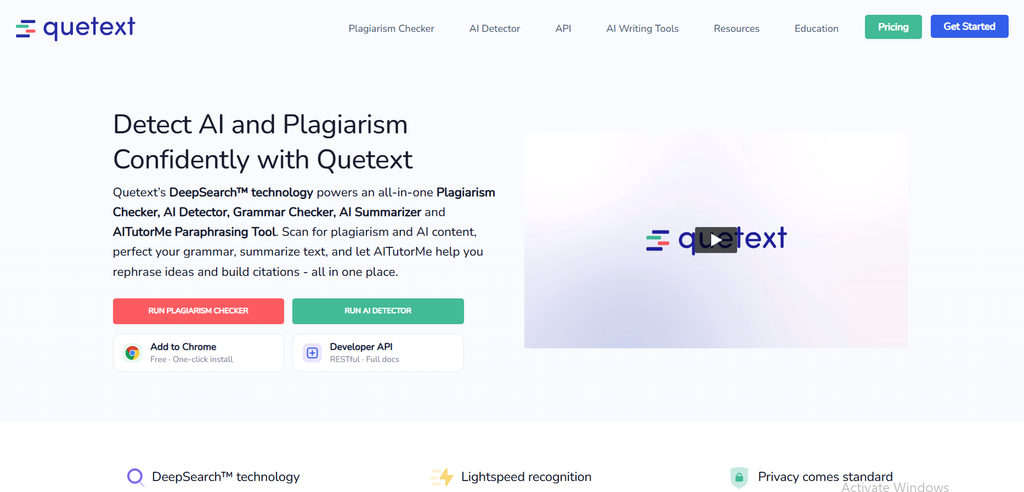
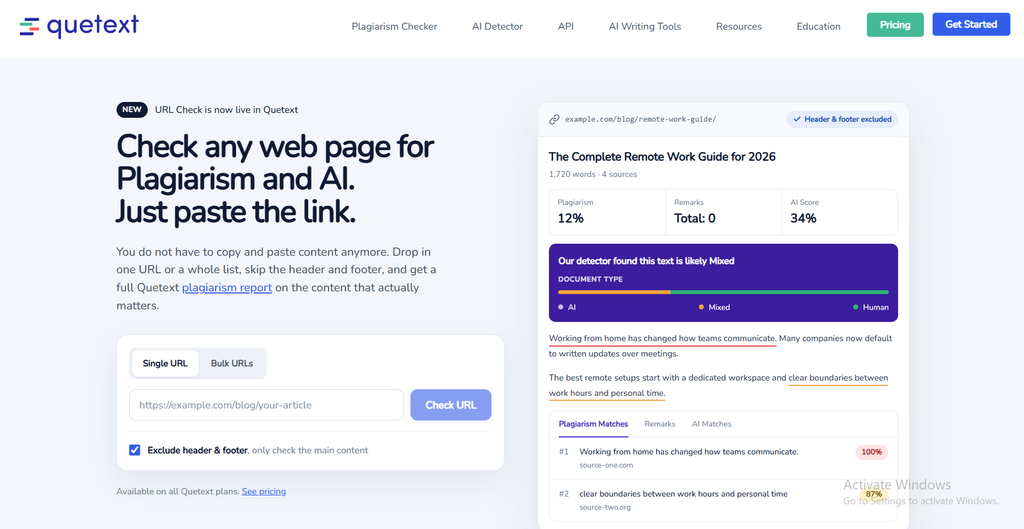
Alongside its scanning engine, Quetext features ColorGrade visual feedback. Instead of delivering an intimidating and unhelpful overall percentage score, the interface color-codes flagged text based on match severity and confidence levels. Over the past few years, the platform has expanded beyond traditional plagiarism to include an automated citation generator, an integrated AI content detector, an AI humanizer, an AI summarizer, and a downloadable PDF reporting engine designed for client and institutional verification.
Hands-On Accuracy Stress Tests
Marketing claims are easy to make, but a plagiarism checker’s true worth is proven only when exposed to deliberate evasion techniques. To evaluate Quetext Pro objectively, I constructed an empirical benchmark test using four distinct writing samples representing different publishing challenges: verbatim copy, automated paraphrasing, pure AI generation, and clean human writing.
Test 1: Verbatim Duplication
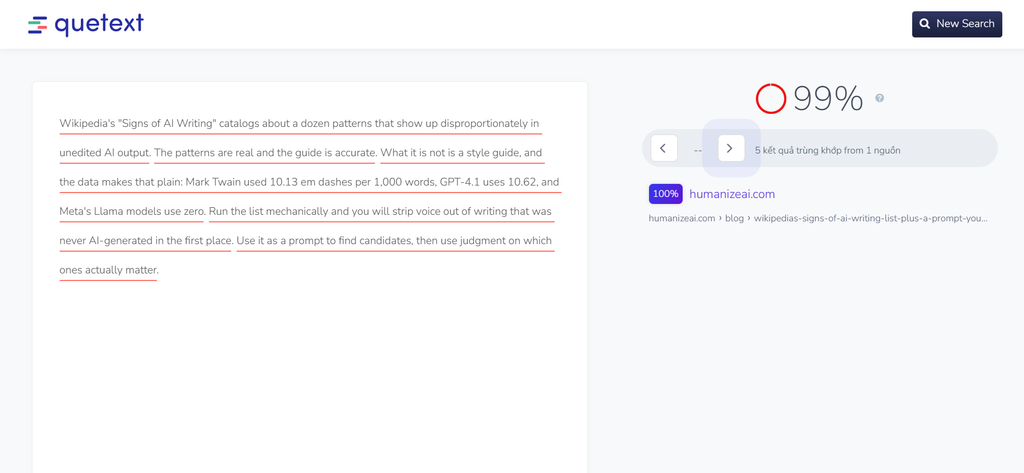
For the first test, I evaluated how reliably Quetext flags raw, unedited text copied directly from published online sources. I extracted three dense paragraphs from a high-ranking technology editorial and pasted them into the editor without changing a single character or punctuation mark.
- Scan Speed and Performance: The 450-word document was fully parsed in roughly eight seconds, indicating responsive server infrastructure even during peak working hours. It loaded the full web attribution report without freezing or dropping the browser session.
- Detection Rate and Severity: Quetext flagged the sample as 100% plagiarized, marking the entire text block in high-severity red highlights across the editing window. There was no ambiguity regarding the copied status of the submission.
- Attribution Accuracy: The ColorGrade panel accurately identified the primary publishing URL on the original website, along with three secondary syndication mirrors that carried the piece. It provided exact side-by-side snippet previews that matched every single word.
Test 2: Paraphrased Content
The true test of any modern scanner is whether it can expose spun content designed to bypass basic search filters. I took an academic research excerpt and ran it through QuillBot’s Paraphraser on the Fluency setting, followed by manual synonym replacements and passive-voice inversions.
- The Paraphrasing Challenge: Every single sentence had its grammatical voice inverted, transition phrases were swapped, and approximately 40% of the original vocabulary was replaced by contextual synonyms. Most free tools rate this kind of spun text as completely unique.
- DeepSearch Detection Results: This is where Quetext demonstrated its superiority over basic string-matching tools. The engine flagged the document as 74% matching, identifying the underlying sentence logic despite the altered vocabulary.
- Fuzzy Match Highlighting: The system used orange and yellow ColorGrade highlights to pinpoint where the syntactic structure and argument progression mirrored the original paper. This confirms that Quetext can reliably detect sophisticated paraphrasing tools even when exact word sequences have been broken up.
Test 3: AI-Generated Content
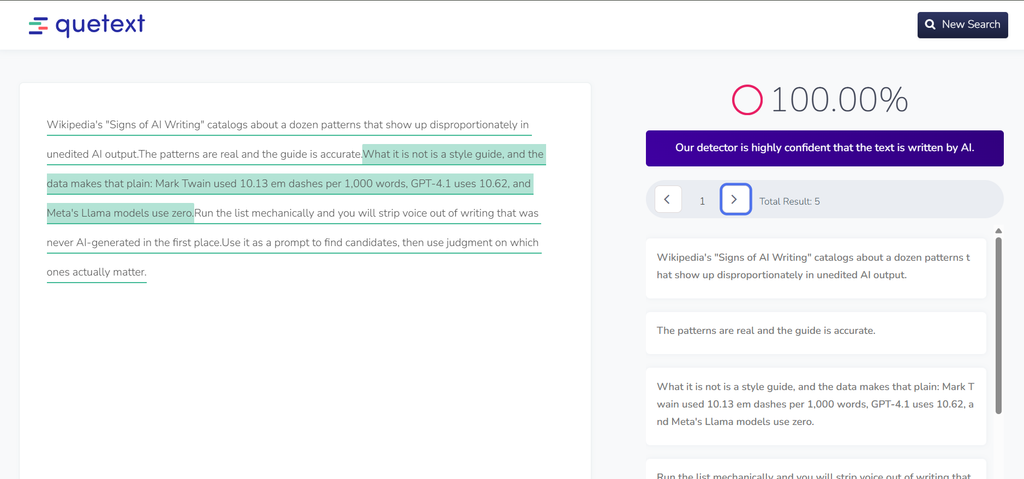
With generative text flooding the web, digital publishers need to know how well the platform separates machine-generated writing from copied text. I generated a fresh 600-word article on renewable energy trends using GPT-4o with no external source material pasted into the prompt.
- Plagiarism Score: As expected, the traditional plagiarism engine returned a clean 0% duplicate score, correctly recognizing that the phrasing was freshly synthesized rather than copied from an indexed webpage.
- Integrated AI Detector Result: Switching to the built-in AI detection module, Quetext labeled the document as 82% likely AI-generated, highlighting formulaic sentence structures and repetitive transition words.
- Sensitivity and False Positives: While it successfully flagged the machine-written draft, subsequent tests revealed that the AI detector can be overly sensitive on dense, technical human writing, making it best suited as an initial screening filter rather than a definitive judge.
Test 4: Original Human Writing
The final test examined how Quetext handles genuine human writing that contains everyday professional idioms. I submitted a completely original, unpublished opinion essay written by an experienced human journalist, filled with industry phrases, common proverbs, and conversational transitions.
- False Alarm Prevention: Low-end scanners often trigger false positives on everyday business phrasing, legal disclaimers, or common idioms, causing unnecessary panic for writers and editors. A reliable scanner must know when to ignore common colloquial language.
- The Originality Outcome: Quetext returned a clean 2% similarity score, accurately identifying two common colloquial idioms as incidental matches without penalizing the overall document score. The tool made it easy to dismiss these minor matches with a single click.
| Test Scenario | Sample Word Count | Quetext Originality Score | Key Detection Finding |
|---|---|---|---|
| Verbatim Web Copy | 450 Words | 100% Plagiarized | Exact URL matched instantly with complete sentence alignment. |
| QuillBot Paraphrased | 520 Words | 74% Similar | DeepSearch fuzzy matching successfully caught structural restructuring. |
| Pure ChatGPT-4o Text | 600 Words | 0% Plagiarized / 82% AI | Correctly separated duplicate content from synthetic text generation. |
| Original Human Draft | 750 Words | 2% Incidental Match | Common idioms flagged harmlessly without false-positive disruption. |
Core Features Tested
A plagiarism checker is only as valuable as the time it saves you during the editorial review process. Beyond its underlying search algorithm, Quetext includes several dedicated workflow utilities that streamline document proofing and citation management.
ColorGrade Reports & Snippet Viewer
The core workspace inside Quetext is built around visual clarity and rapid verification. When a scan finishes, the left side of your screen displays your text, while the right pane loads interactive snippet comparison cards that eliminate the need to cross-check sources in separate browser tabs.
- Side-by-Side Verification: Clicking on any highlighted sentence in your document instantly displays your text alongside the source snippet pulled from the live web, showing matching words in bold. This makes it effortless to determine whether an overlap is accidental or intentional.
- Match Severity Sorting: Red highlights signify high-probability verbatim overlap that requires immediate rewriting or quoting, while orange and yellow markers indicate fuzzy contextual similarities or common phrasing.
- Exportable PDF Reports: With a single click, you can download a branded PDF report showing the exact percentage score, date of scan, and a catalog of matching sources. This provides an indispensable audit trail for freelance writers who need to prove original work to demanding agency clients.
Built-In Citation Assistant
For academic researchers, college students, and long-form essayists, manual bibliography formatting is a frustrating time sink. Quetext integrates an automated citation engine directly into its duplicate match cards, turning an annoying editing chore into a single-click workflow.
- One-Click Referencing: When Quetext flags a legitimate source that you intended to cite, clicking the Citation Assistant button pulls the author name, publication title, date, and URL metadata automatically from the target web page.
- Style Flexibility: You can toggle citations between APA, MLA, and Chicago formatting styles on the fly, allowing you to adapt your paper to different academic and editorial style guides instantly.
- Bibliography Generation: The tool automatically formats in-text citations and compiles a clean works-cited list at the bottom of your document, saving up to thirty minutes of tedious manual formatting per research paper.
Privacy & Data Security
One of the greatest fears among freelance writers and students is the data-storage policy of scanning software. If you work under non-disclosure agreements or intend to submit university coursework, privacy is not an afterthought: it is an absolute operational requirement.
Many students have experienced the Turnitin dilemma: submitting a preliminary draft to a rogue third-party checker, only for the tool to deposit the text into a global repository. When the final paper is submitted to their university professor weeks later, the institutional scanner flags the student’s own work as 100% plagiarized. Worse, shady free scanners frequently monetize their platforms by selling uploaded drafts to essay mills, academic scraping databases, and commercial advertisers.
If you are asking whether Quetext is safe for confidential client work, the answer is an unequivocal yes. Quetext’s official privacy documentation explicitly guarantees three vital protections:
- No Data Selling: Your uploaded drafts are never sold, rented, or licensed to third-party databases, commercial advertisers, or academic marketplaces under any circumstances.
- No Public Comparison Repository: Scanned content is never added to a shared comparison database. Your documents remain tied exclusively to your private account, meaning future scans of revised drafts will never flag your past work as duplicate content.
- Complete Intellectual Property Ownership: You maintain 100% legal copyright ownership over all submitted files, allowing freelance ghostwriters and agencies bound by strict non-disclosure agreements to scan proprietary copy with complete peace of mind.
Web Publishers vs. Academic Users
Because content creators and academic researchers operate with fundamentally different goals, understanding where Quetext fits into your broader software stack prevents buyer remorse. A tool that works brilliantly for an academic essay may lack the automated features an SEO agency demands for site-wide monitoring.
Best for Freelancers and Students
For independent creators and college researchers, Quetext provides institutional-grade detection without institutional bureaucracy. It bridges the gap between unreliable free scanners and locked-down university software:
- Zero Gatekeeping: You do not need a university email address, an academic department subscription, or an enterprise license to run professional-grade scans. Anyone can sign up and verify their papers independently.
- Visual Audit Trails: Generating clean, shareable PDF originality certificates provides tangible proof of originality when submitting freelance deliverables to clients or professors.
- Instant Academic Sourcing: The built-in citation generator completely eliminates the need for separate citation tools, keeping your writing and sourcing in a single unified window.
Limitations for SEO Agencies
While Quetext is exceptional for pre-publication document editing, it lacks specialized tools that enterprise digital publishers and SEO teams rely on for ongoing brand protection:
- No Automated URL Crawling: In the debate of Quetext versus Copyscape, Copyscape’s Copysentry feature automatically monitors your live website every week and alerts you if another blogger scrapes your published articles. Quetext offers no automated domain-monitoring tool.
- No Batch Sitemap Audits: You cannot submit an entire XML sitemap containing 500 published URLs to check for site-wide duplication or internal content cannibalization.
- Subscription vs. Pay-As-You-Go: High-volume agencies with erratic monthly workloads often prefer paying three cents per search on Copyscape rather than committing to a monthly subscription with word caps that expire at the end of each billing cycle.
Quetext Pricing & Plans
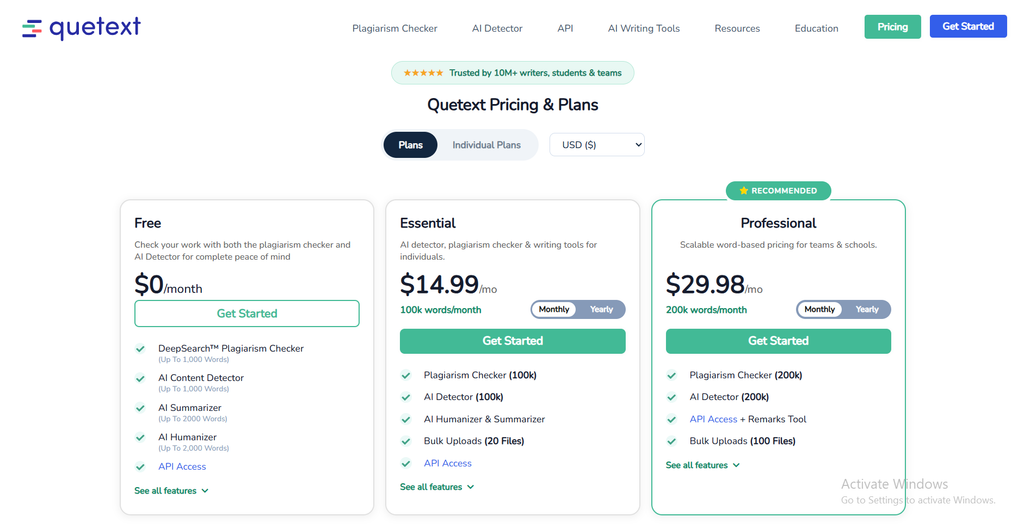
Quetext organizes its pricing into two clear structures: comprehensive all-in-one bundles and cost-effective individual standalone plans. This separation allows users to choose between a complete suite of writing and detection tools or pay only for the exact utility they need.
Below is the verified breakdown of current Quetext pricing plans, monthly word allotments, and included features:
All-in-One Multi-Tool Bundles
| Plan Name | Monthly Price | Word Allowance | Core Features Included | Best-Fit User Profile |
|---|---|---|---|---|
| Free | $0 / month | Up to 1,000 Words | DeepSearch (1k), AI Detector (1k), Summarizer & Humanizer (2k), API Access | Casual users testing basic features |
| Essential | $14.99 / month | 100,000 Words / month | Plagiarism Checker (100k), AI Detector (100k), Humanizer & Summarizer, Bulk Uploads (20 Files), API Access | Solo bloggers, freelance writers, editors |
| Professional | $29.98 / month | 200,000 Words / month | Plagiarism Checker (200k), AI Detector (200k), Remarks Tool, Bulk Uploads (100 Files), API Access | Content marketing teams, agencies, schools |
Individual Standalone Plans
For creators who do not need a full suite of AI writing tools, Quetext offers targeted single-purpose plans:
| Plan Name | Monthly Price | Word Allowance | Core Features Included | Best-Fit User Profile |
|---|---|---|---|---|
| Plagiarism Checker Only | $9.99 / month | 50,000 Words / month | DeepSearch (50k), Grammar & Spell Check, Originality Reports, API Endpoints | Writers needing pure plagiarism defense |
| AI Detector Only | $7.99 / month | 50,000 Words / month | AI Content Detector (50k), Line-By-Line AI Analysis, Shareable Reports, API Access | Editors vetting incoming freelance AI text |
Choosing Between Bundles and Standalone Plans
The introduction of dedicated standalone plans offers tremendous budget flexibility. If you only need to ensure your articles are free of web duplication, the $9.99 per month Plagiarism Checker Only plan gives you 50,000 words along with downloadable reports and grammar checks.
If your workflow requires both plagiarism detection and AI screening, the $14.99 per month Essential plan is the sweet spot. It doubles your monthly capacity to 100,000 words across both engines and unlocks bulk file uploads for up to 20 documents simultaneously. For high-volume agencies and educational departments, the $29.98 per month Professional tier provides 200,000 words, the Remarks collaboration tool, and bulk processing for up to 100 files at once. Discounted annual billing options are also available across paid tiers.
Quetext Pros and Cons
To provide a fair and balanced assessment before you enter your payment details, I compiled an objective summary of Quetext’s primary strengths alongside its operational trade-offs based on daily testing:
Pros
Cons
Pros
The platform delivers several industry-leading advantages that streamline document editing and protect content originality:
- Proprietary DeepSearch Technology: Consistently catches sophisticated paraphrasing, inverted clauses, and spun sentences that simple string matchers miss completely.
- Intuitive ColorGrade Reports: Color-coded side-by-side snippet comparisons make investigating duplicate sources exceptionally fast and visual.
- Integrated Citation Assistant: Formats APA, MLA, and Chicago bibliography citations directly from matched sources with a single click.
- Targeted Standalone Plans: The option to purchase Plagiarism Only ($9.99/mo) or AI Detection Only ($7.99/mo) prevents paying for unused tools.
- Strict Privacy Policy: Uploaded content is never added to a public comparison database or sold to third-party marketplaces, protecting client confidentiality.
- Useful Free Allowance: The free tier includes up to 1,000 words for both DeepSearch and AI detection, plus 2,000 words for the AI Summarizer and Humanizer.
Cons
Despite its practical strengths, there are several workflow limitations to consider before subscribing:
- No Published URL Monitoring: Lacks automated domain scanning to detect when competitors scrape your live, published blog posts.
- Average AI Detector: The standalone AI content detection tool produces higher false-positive rates on technical human writing than specialized scanners like Originality.ai.
- No Word Rollover: Unused monthly word allocations expire at the end of each billing cycle rather than rolling over indefinitely.
- Word Caps on Standalone Plans: The $9.99 standalone plan is capped at 50,000 words, which may feel tight for prolific weekly publishers.
Quetext vs. The Competition
Choosing the right verification software depends on whether you are auditing unpublished drafts or monitoring a live digital publication. Below is how Quetext compares to its primary market rivals across core operational features:
| Feature / Criteria | Quetext (Essential / Standalone) | Copyscape Premium | Originality.ai | Grammarly Premium |
|---|---|---|---|---|
| Pricing Model | Subscription ($9.99 to $14.99/mo) | Pay-as-you-go ($0.03/search) | Pay-as-you-go or Sub ($14.95/mo) | Subscription (~$12–$30/mo) |
| Included Monthly Words | 50,000 to 100,000 Words | Credit-based per search | 100,000 to 200,000 Credits | Unlimited Grammar / Plagiarism |
| Paraphrase / Fuzzy Matching | Exceptional (DeepSearch) | Basic to Moderate | Industry Best | Basic String Match |
| Automated Citation Tool | Yes (APA, MLA, Chicago) | No | No | Basic suggestions only |
| Live URL Site Monitoring | No | Yes (Copysentry) | No | No |
| Best-Fit Audience | Freelancers, Editors, Students | SEO Webmasters & Publishers | Agencies & AI-First Editors | General Writers & Proofreaders |
Comparison Insight
If you need to catch spun sentences in draft articles and format citations, Quetext is superior. If you need to audit an entire published website for stolen content, Copyscape remains the standard tool.
Quetext vs. Copyscape
Copyscape has been the industry standard for SEOs for over two decades. Its pay-as-you-go pricing, costing roughly three to five cents per search, is ideal for site owners who only check an occasional article and prefer not to pay a recurring subscription fee.
However, Copyscape’s interface is dated, and its core engine relies heavily on verbatim string matches. Quetext’s DeepSearch is significantly better at catching restructured sentences, synonym replacement, and spun content, making Quetext the superior choice for vetting freelance writer submissions before publication.
Quetext vs. Grammarly & Turnitin
In the comparison of Quetext versus Turnitin, Turnitin has a deeper reach into locked academic research repositories and private journal databases, but it is strictly gatekept behind university institutional licensing and permanently stores student papers in a global archive. Quetext provides comparable fuzzy-matching accuracy for open web sources without the risk of repository trapping.
Compared to Grammarly Premium, Grammarly is a superior comprehensive copyediting tool for punctuation, tone, and grammar. However, Grammarly’s built-in plagiarism tool is notoriously rigid, flagging only exact word sequences while missing subtle paraphrasing and offering virtually no automated citation formatting.
Who Should Use Quetext?
Because content integrity tools serve distinct publishing needs, matching Quetext to your exact production workflow ensures positive software ROI. The platform is not a one-size-fits-all solution, but for specific user profiles, it represents the ideal tool.
Who Should Buy Quetext
If your primary workflow involves reviewing individual drafts before they go live, Quetext is purpose-built for you:
- Freelance Writers & Ghostwriters: Creators who need to verify their drafts, eliminate accidental phrasing overlaps, and send clean, branded PDF originality reports to clients to prove authenticity.
- Content Editors & Boutique SEO Agencies: Editors managing multiple remote writers who need to ensure submitted articles are not spun from competitor blogs or reworded using automated spinning software.
- College Students & Academic Researchers: Writers who must format research citations accurately in APA, MLA, or Chicago styles and cannot risk uploading drafts to tools that index papers into public databases.
Who Should Skip Quetext
For specific enterprise publishing operations, alternative platforms provide a better architectural fit:
- Enterprise Publishers Auditing Published Domains: If you manage a 1,000-page media publication and need automated weekly alerts whenever another site steals your content, use Copyscape Copysentry.
- Agencies Focused Strictly on Catching AI Content: If your primary mandate is detecting GPT-4, Claude, or Gemini content with high confidence, detailed perplexity scores, and team API integrations, choose Originality.ai or Winston AI.
How to Choose the Right Checker
Before purchasing any content integrity software, taking time to analyze your editorial requirements will prevent wasted budget. Run your operational needs through this four-part decision framework:
- Evaluate Detection Sensitivity: Determine whether your workflow only requires catching lazy copy-paste plagiarism (where basic string searchers suffice), or if you must detect spun, paraphrased, and synonym-replaced content (where DeepSearch is required).
- Review Data Privacy and Repository Policies: Never use a tool that reserves the right to store your submitted drafts in a shared comparison database, particularly if you handle proprietary client assets or academic thesis papers.
- Align Your Word Volume with Billing Models: If you scan a predictable 20,000 to 80,000 words every month, a flat subscription like Quetext is far more economical than pay-per-search tools. If you only scan three articles a year, a pay-as-you-go platform like Copyscape makes more financial sense.
- Identify Essential Companion Features: Factor in whether built-in tools (such as automated citation generation, grammar proofreading, or PDF export certificates) eliminate the need for secondary software subscriptions.
Frequently Asked Questions
Prospective users frequently ask about scanning precision, privacy policies, and subscription constraints before upgrading. Here are direct, verified answers to the most common questions about Quetext:
Final Verdict: Is Quetext Pro Worth It?
In an online publishing landscape increasingly crowded with spun freelance drafts and automated content, verifying authenticity before hitting publish is essential. Quetext succeeds decisively by balancing deep, contextual detection with one of the cleanest visual interfaces in the industry.
While it does not offer automated domain-monitoring for published blogs and its AI detector is best viewed as a secondary check, its core plagiarism engine is outstanding. For freelance writers, editors, and students, the ability to catch paraphrased content, export professional PDF certificates, and generate accurate citations in a single click makes Quetext well worth its starting price of $9.99 to $14.99 per month.
- Final Decision: If you review individual written drafts and want reliable paraphrase detection with instant citation formatting, Quetext is an exceptional operational investment.
- Next Step: Start Your Quetext Scan Today and test the DeepSearch engine on your most challenging draft.
Looking to audit content quality and scale your website traffic? Explore our complete hub of SEO Tools to discover in-depth comparisons of rank trackers, keyword research platforms, and site audit utilities at Trend Level Tech.