The proprietary trading industry has exploded in recent years, offering talented retail traders unprecedented access to significant capital.
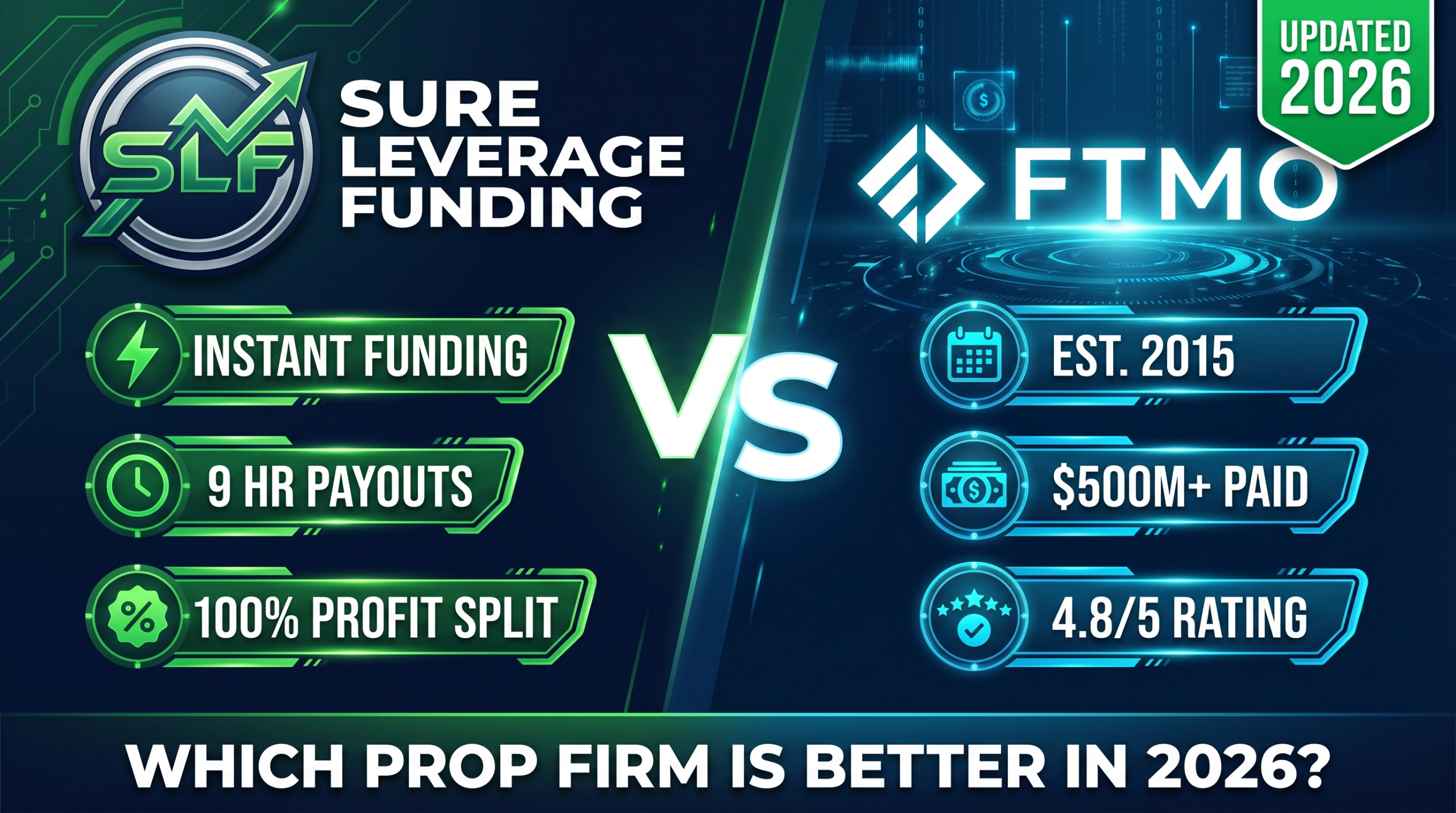
Among the dozens of firms operating today, two names frequently dominate the conversation for very different reasons: Sure Leverage Funding and FTMO.
FTMO is widely considered the grandfather of the modern prop firm industry, having established the two-step evaluation model that became the industry standard.
Sure Leverage Funding, on the other hand, represents the new wave of “instant funding” firms that bypass the evaluation phase entirely, offering immediate access to live-simulated capital.
If you are a profitable trader looking to scale your capital in 2026, you are likely weighing these two distinct business models against each other.
In this comprehensive Sure Leverage Funding vs FTMO comparison, we will dissect every aspect of these two industry giants.
We will analyze their pricing structures, trading rules, payout speeds, and profit splits to determine which firm offers the best environment for your specific trading style.
The choice between these two platforms is not merely a matter of preference; it is a strategic business decision that will dictate your cash flow for months to come.
Proprietary trading has evolved from a niche corner of the internet into a multi-billion dollar industry, and the competition between firms has never been fiercer.
This competition has forced companies to innovate, leading to the diverse range of funding models we see today.
As a trader, your job is to navigate this complex landscape and identify the firm that offers the highest probability of success based on your unique psychological profile and trading methodology.
Some traders thrive under the structured, milestone-driven environment of an evaluation.
Others find that artificial targets destroy their edge, and they require the freedom of instant capital to perform at their best.
By the end of this comparison, you will have absolute clarity on which path is the mathematically and psychologically correct choice for your trading career.
1. Overview of Both Platforms
Before diving into the granular details, it is crucial to understand the fundamental difference in business models between these two companies.
They cater to different demographics and operate on entirely different risk paradigms.
FTMO: The Evaluation Pioneer
Based in Prague, FTMO has been operating since 2015 and is universally recognized as the most trusted name in the proprietary trading space.
Their business model is built around a strict two-step evaluation process.
To access FTMO’s capital, a trader must first pass the “FTMO Challenge” (Phase 1) by hitting a 10% profit target without breaching a 5% daily or 10% maximum drawdown.
After passing Phase 1, the trader must pass the “Verification” (Phase 2) by hitting a 5% profit target under the same drawdown constraints.
Only after successfully navigating both phases—which can take weeks or months—does the trader receive a funded account where they can earn real money.
Sure Leverage Funding: The Instant Access Innovator
Sure Leverage Funding operates on the “instant funding” model, which completely eliminates the evaluation phase.
There are no profit targets to hit, no Phase 1, and no Phase 2.
When a trader purchases an account, they are immediately provided with live-simulated capital.
From the very first trade, any profit generated above the starting balance belongs to the trader (subject to the profit split ratio).
Because the firm is taking on significantly more upfront risk by funding traders without testing them first, the entry fees are substantially higher than FTMO’s evaluation fees.
2. Sure Leverage Funding vs FTMO: Feature Comparison
Let us look at a direct side-by-side comparison of the core features offered by both proprietary trading firms.
| Feature | Sure Leverage Funding | FTMO |
|---|---|---|
| Funding Model | Instant Funding (No Evaluation) | 2-Step Evaluation |
| Profit Target | None Winner | 10% (Phase 1), 5% (Phase 2) |
| Time Limits | Unlimited | Unlimited |
| Max Drawdown | 5% (Static) | 10% (Trailing) Winner |
| Daily Drawdown | 3% – 4% | 5% Winner |
| Profit Split | Up to 100% | Up to 90% |
| First Payout | Anytime (Avg 9 hours) Winner | After 14 days of live trading |
| Weekend Holding | Allowed | Requires specific Swing account |
As the table illustrates, the Sure Leverage Funding vs FTMO debate comes down to a trade-off between speed and drawdown limits.
Sure Leverage Funding offers unparalleled speed—no profit targets and instant payouts—but enforces tighter drawdown constraints.
FTMO requires you to jump through hoops to prove yourself, but rewards you with wider drawdown limits once you are funded.
3. Sure Leverage Funding vs FTMO: Pricing Comparison
Pricing is where the difference between the two business models becomes starkly apparent.
Because FTMO makes a significant portion of its revenue from traders failing the evaluation, they can afford to keep the entry fee relatively low.
Sure Leverage Funding assumes immediate risk, so their upfront fees are much higher.

The $100,000 Account Example
Let us compare the cost of acquiring a $100,000 account at both firms.
At FTMO, the fee for a $100,000 evaluation challenge is approximately $540 (depending on exchange rates, as they charge in Euros).
If you successfully pass Phase 1 and Phase 2, this $540 fee is fully refunded to you with your first profit split.
At Sure Leverage Funding, purchasing a $100,000 instant funding account will typically cost between $4,500 and $5,000.
This fee is non-refundable. It is the premium you pay to bypass the evaluation.
The True Cost of Capital
On the surface, FTMO appears drastically cheaper.
However, professional traders calculate the “true cost” of capital differently by factoring in opportunity cost.
If you are a skilled trader who averages a 5% return per month, spending two months passing an FTMO evaluation means you missed out on $10,000 in potential profits.
In that scenario, paying $5,000 upfront to access the capital immediately and capturing that $10,000 profit is actually the more profitable mathematical decision.
Conversely, if you are a beginner who is likely to blow the account, losing $540 at FTMO is far less painful than losing $5,000 at an instant funding firm.
It is also important to consider the psychological impact of these pricing models.
When a trader pays a small fee for an evaluation, they often treat the account with less respect, leading to reckless trading behavior and repeated failures.
This cycle of paying small fees repeatedly can quickly add up, sometimes surpassing the cost of a single instant funding account.
Conversely, the substantial upfront investment required for instant funding forces the trader to take the endeavor incredibly seriously from the very first execution.
This heightened state of focus and discipline often translates to better risk management and more consistent profitability.
Furthermore, some traders utilize a hybrid approach to pricing and capital acquisition.
They might purchase a smaller instant funding account to generate immediate cash flow, and then use those profits to fund multiple evaluation challenges at firms like FTMO.
This strategy allows them to build a massive portfolio of funded accounts across different firms while minimizing their out-of-pocket risk.
Ultimately, the pricing comparison is not just about the dollar amount on the checkout page; it is about how that cost aligns with your overall business plan as a professional trader.
Want to bypass the evaluation phase?
If you are a profitable trader ready to monetize your skills immediately, instant funding is the fastest route to real payouts.
4. Sure Leverage Funding vs FTMO: Trading Rules and Drawdowns
The rules governing how you can trade are just as important as the price you pay for the account.

Drawdown Limits
FTMO offers a generous 10% maximum drawdown and a 5% daily drawdown.
However, FTMO’s maximum drawdown is trailing during the funded stage (up to the starting balance), which means if you make profit, your loss limit moves up with your account balance until it locks at your initial balance.
Sure Leverage Funding utilizes a static drawdown model, typically set at 5% maximum and 3% to 4% daily.
While the percentage is smaller, the static nature is a massive advantage.
A static drawdown means your loss floor never moves. If you have a $100,000 account with a 5% static drawdown, your account is only breached if your equity drops below $95,000.
If you grow the account to $110,000, your breach level remains at $95,000—giving you a massive $15,000 buffer to trade with.
Trading Style Restrictions
FTMO is generally more accommodating of automated trading.
They allow the use of Expert Advisors (EAs) and trading bots during both the evaluation and funded stages, provided the EA is not executing prohibited strategies like high-frequency trading (HFT) or latency arbitrage.
Sure Leverage Funding is stricter regarding automation.
They generally prohibit the use of EAs on their standard instant funding accounts, preferring traders who execute manual, discretionary strategies based on technical or fundamental analysis.
Both firms allow news trading, but FTMO requires you to purchase a specific “Swing” account if you wish to hold trades over the weekend or during major macroeconomic news releases.
Sure Leverage Funding allows weekend holding by default on most of their account tiers.
5. Sure Leverage Funding vs FTMO: Payout Speed and Profit Splits
Getting funded is only half the battle; actually receiving your profits is what matters.

Payout Speed
This is an area where Sure Leverage Funding completely dominates the competition.
They have built their entire brand reputation around ultra-fast payouts.
Once you request a withdrawal, it is typically processed within an average of 9 hours.
They are so confident in their payout infrastructure that they offer a guarantee: if an eligible payout takes longer than 24 hours, they will add a 10% bonus to your withdrawal amount.
Furthermore, there are no minimum trading days required. If you make a profit on day one, you can withdraw it on day one.
FTMO, while incredibly reliable, operates on a slower, more traditional schedule.
Your first payout with FTMO can only be requested after 14 days of trading on the live funded account.
Subsequent payouts can be processed bi-weekly, but the initial waiting period is a significant delay compared to instant funding.
Profit Splits
FTMO starts traders on an 80/20 profit split.
If you consistently generate profits over several months, you can qualify for their scaling plan, which increases your account size by 25% and bumps your profit split up to 90/10.
Sure Leverage Funding also offers highly competitive splits, often starting at 80% but frequently running promotions that push the split to 90% or even 100% for the first few payouts.
Both firms are top-tier in this regard, ensuring that the trader keeps the vast majority of the wealth they generate.
Another critical aspect of trading rules is the consistency rule, which some firms use to deny payouts.
A consistency rule typically dictates that no single trade can account for more than a certain percentage (e.g., 50%) of your total profits.
This is designed to prevent gamblers from getting lucky on one massive “all-in” trade and then coasting to a payout.
FTMO is famous for not having any hidden consistency rules during the funded stage, allowing traders the freedom to capitalize heavily on high-conviction setups.
Sure Leverage Funding also prides itself on transparent rules without predatory consistency clauses that trap successful traders.
However, because they assume immediate risk, their risk team closely monitors accounts for toxic trading behavior.
Toxic behavior includes exploiting platform latency, hedging across multiple accounts to guarantee a win, or utilizing martingale strategies that mathematically guarantee a blown account eventually.
If you trade with a genuine edge—using proper stop losses, sensible position sizing, and logical market analysis—you will not encounter issues with the rules at either of these top-tier institutions. For more on building a trading edge, check out this guide on building a trading edge on Investopedia.
The key is to read the Terms of Service carefully before purchasing an account, as ignorance of a specific rule is never accepted as an excuse for a breached account.
6. Pros & Cons of Each
To summarize the Sure Leverage Funding vs FTMO comparison, let us distill the strengths and weaknesses of both platforms.
Sure Leverage Funding Pros:
- Instant Access: No evaluation phases, no profit targets to hit.
- Lightning Payouts: Average 9-hour processing time with a 24-hour guarantee.
- Static Drawdown: Your loss floor never trails your profits, giving you breathing room as your account grows.
- No Time Limits: Trade at your own pace without the psychological pressure of a deadline.
Sure Leverage Funding Cons:
- High Upfront Cost: Instant funding is significantly more expensive than evaluation challenges.
- Tighter Drawdowns: 5% maximum drawdown leaves less room for error during losing streaks.
- EA Restrictions: Automated trading bots are generally not allowed.
FTMO Pros:
- Industry Leader: Impeccable reputation, operating successfully since 2015.
- Low Entry Cost: Evaluation challenges are highly affordable.
- Wider Drawdowns: 10% maximum drawdown provides a generous safety net.
- Refundable Fee: The challenge fee is refunded with your first profit split.
FTMO Cons:
- Time Consuming: Passing two evaluation phases can take weeks or months.
- Opportunity Cost: You earn zero money while passing the evaluations.
- Trailing Drawdown: The maximum drawdown trails your balance until it locks at the starting equity.
The mechanics of receiving a payout also differ slightly in terms of administrative requirements.
FTMO has a highly streamlined dashboard where you can request payouts, generate certificates of achievement, and even access detailed statistical analysis of your trading performance.
Their infrastructure is robust, reflecting years of development and millions of dollars in technological investment.
Sure Leverage Funding, being a newer entrant focused on the instant funding model, prioritizes raw speed over extensive analytical tools.
Their dashboard is functional and clean, designed primarily to facilitate rapid withdrawals rather than deep dive analytics.
For traders who use third-party journaling software like TradeZella or Edgewonk, the lack of built-in analytics is irrelevant.
However, traders who rely on their prop firm to provide performance insights might prefer FTMO’s comprehensive suite of tools.
Additionally, the tax implications of receiving payouts via cryptocurrency versus bank wire should be considered.
While crypto offers unparalleled speed, it introduces exchange rate volatility and complex tax reporting requirements in many jurisdictions.
Traders utilizing the lightning-fast crypto payouts from instant funding firms must be diligent in tracking the fiat value of their withdrawals for tax purposes.
Still undecided?
Read our comprehensive, standalone review of Sure Leverage Funding to see verified payout proofs and a deep dive into their specific trading rules.
7. Which is Better for Beginners?
If you are a beginner or an intermediate trader who is not yet consistently profitable, the winner is clear.

FTMO is the superior choice for beginners.
When you are still refining your strategy and mastering your trading psychology, you are statistically highly likely to fail your first few prop firm attempts.
Failing a $540 FTMO challenge is a relatively inexpensive learning experience.
Failing a $5,000 instant funding account is a devastating financial blow.
Furthermore, the evaluation process itself acts as a necessary filter.
If you cannot demonstrate the discipline required to pass a two-step evaluation, you do not possess the discipline required to manage live capital without blowing it.
FTMO’s wider 10% drawdown limit also provides beginners with a much-needed cushion to survive inevitable losing streaks while they dial in their edge.
8. Which is Better for Advanced Traders?
If you are a veteran trader with a proven edge, strict risk management, and a verifiable track record of profitability, the equation flips entirely.
Sure Leverage Funding is the superior choice for advanced professionals.
For a professional, time is literally money.
Spending two months trading flawlessly on an FTMO demo account just to “prove” yourself represents a massive opportunity cost.
If your system generates 5% a month, applying that system to a $100,000 instant funding account yields $5,000 in your pocket by the end of month one.
The higher upfront fee is simply a business expense—a cost of acquiring immediate leverage.
Additionally, professional traders highly value the static drawdown model.
Once an experienced trader builds a 3% or 4% profit buffer on an instant funding account, the static drawdown means their account is incredibly secure, allowing them to scale their position sizing with confidence.
9. Final Verdict
Concluding the Sure Leverage Funding vs FTMO debate requires acknowledging that neither firm is objectively “better” in a vacuum.
They are simply the best tools for two entirely different jobs.
If you need a low-cost entry point, generous drawdown limits, and are willing to invest the time to prove your skills, FTMO remains the undisputed king of the evaluation model.
They are the safest, most reliable option for traders building their careers.
However, if you are an established, profitable trader who views capital acquisition purely through the lens of ROI and opportunity cost, Sure Leverage Funding is the clear winner.
Their instant funding model, combined with 9-hour payouts and static drawdowns, provides the most efficient vehicle on the market for turning trading skill into immediate cash flow.
Stop wasting months on demo evaluations if you already know how to trade.
Pay the premium, get funded today, and request your first payout tomorrow.
It is also worth noting that the proprietary trading industry is constantly evolving.
Firms regularly update their rules, adjust their pricing, and introduce new account types to stay competitive.
While this comparison reflects the landscape in 2026, successful traders must remain adaptable and continuously evaluate their funding partners.
Diversification is a core principle of risk management, and it applies to prop firms just as it applies to trading assets.
Many elite traders do not choose between Sure Leverage Funding and FTMO; they use both.
They might hold a massive $400,000 portfolio with FTMO for long-term, steady growth, while simultaneously managing a $100,000 instant funding account for aggressive, short-term cash flow.
This hybrid approach mitigates the risk of any single firm changing its rules or facing regulatory hurdles, ensuring the trader’s income stream remains uninterrupted.
Whatever path you choose, remember that the capital is only leverage for your existing skill.
No prop firm, regardless of how generous its rules or how fast its payouts, can make a bad trader profitable.
Focus on your edge, manage your risk ruthlessly, and treat your funded account with the utmost professionalism.
Ready to start your funded journey?
If you have the skills to succeed without an evaluation, visit Sure Leverage Funding today to select your account size and start trading live capital immediately.